
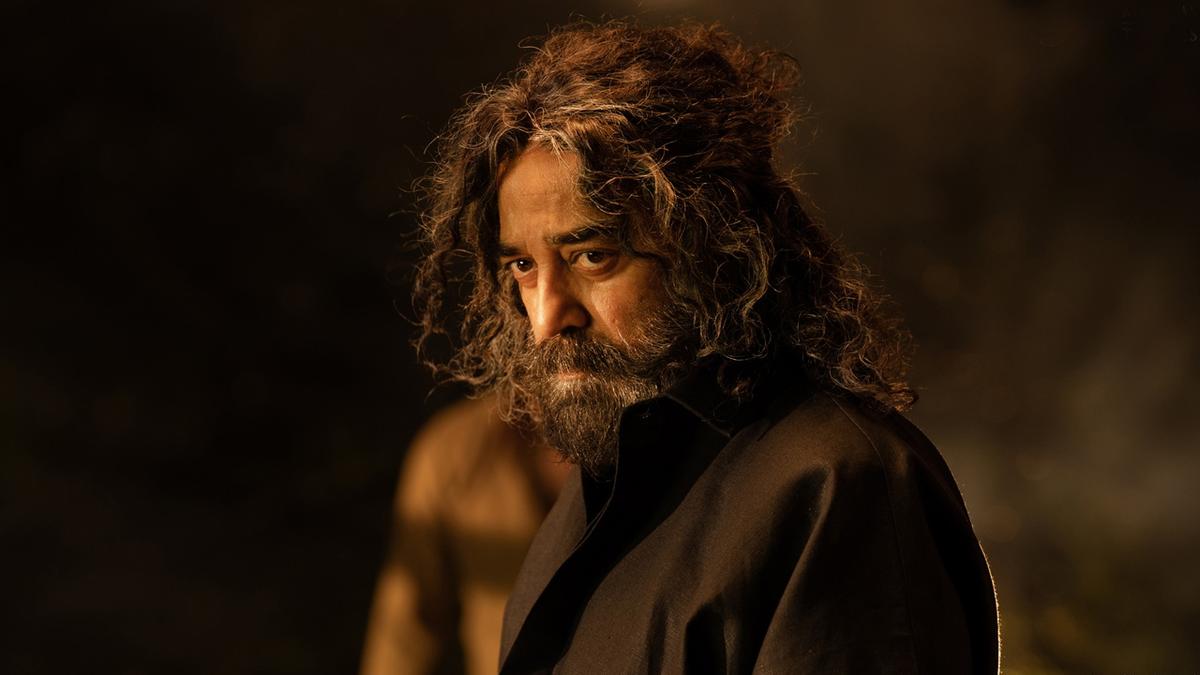
Spoiler-free review. Spoiler review below.
Celebrated director Mani Ratnam returns following his biggest project 'Ponniyin Selvan' to form a long awaited second collaboration with Kamal Haasan. Their first film together 1987’s ‘Nayakan’ revolutionised Tamil cinema through its scope and novel cinematic sensibility. Often heralded as one of the most important films in Tamil cinema history, viewers waited decades for another opportunity to see what the duo would conjure up next. Haasan provided a voiceover for 'Ponniyin Selvan' and now they have released the much anticipated ‘Thug Life,’ co-starring Silambarasan TR, Trisha Krishnan and Nasser.
The film follows Rangaraya Sakthivel Naicker, an underworld don who adopts a child following a rendezvous gone wrong. We then track Naicker in the later stages of his life and watch his relationships and betrayals, understanding how heavy the crown is for the one who bears it. Among his plethora of other enviable talents, Kamal Haasan has proved himself time and again to be one of the finest storytellers in Tamil cinema. Films like ‘Thevar Magan,’ ‘Hey Ram,’ ‘Aalavandhaan’ and ‘Dasavatharam’ depict the range, depth and intelligence with which Haasan approaches his film writing. ‘Thug Life’ is no exception. The themes and craft of putting the story together is extremely impressive, achieving a level of nuance rarely seen in Tamil films. Mani Ratnam’s direction matches this, with stylish sequences shot with a quietly confident panache.
The actors perform well here too. Kamal Haasan plays the role of an aging gangster with a troubled mind once again with ease. Silambarasan’s maturity in his performance is evident too. It is difficult to pick a standout performance from a cast of equally good performances.
The film is technically solid too. Apart from a few instances of choppy slow motion sequences, the film flows smoothly thanks to editor A Sreekar Prasad. Ravi K Chandran’s cinematography is visually striking, with some excellent instances of blocking. The opening sequence makes excellent use of its black and white gradient, where the camera movement and framing are stunning. The film has a unique look and feel to it due to some creative choices with camera angles and lens choices. Although a lot of the action is well choreographed, it feels weighty and out of place in what could otherwise have been a brooding gangster drama. There are also a few creative missteps, especially in the characterisation of Silambarasan’s Amaran and some of the less nuanced dialogue choices especially in the second half of the film.
Although his score and soundtrack acknowledge the brief, AR Rahman’s work here slightly misreads the assignment. Ratnam once again trims a lot of the tracks, using them predominantly as score instead of standalone song sequences. The best song in the album - and perhaps the best song of the year so far, ‘Muththa Mazhai,’ is left out of the film, which is completely understandable as it would have created unwanted lag in the narrative. I hope to hear many more Siva Ananth collaborations with Rahman in the future, as there is an undeniable synergy between them, having written my personal favourite track from 'Ponniyin Selvan I,' ‘Alaikadal.' Ananth also pens the other standout track in the soundtrack ‘Engeyo,’ a light jazzy number which perhaps best fits the film sonically. However, the tracks that work to the film’s detriment by tonally clashing with it are the Paal Dabba written and sung ‘O Maara’ and the overly bombastic ‘Vinveli Nayaga’ sung by Haasan’s daughter Shruthi Haasan. Although it is not Rahman’s best work, the track ‘Sugar Baby’ slips nicely into the accompanying montage style picturisation.
Overall, ‘Thug Life’ is certainly an ambitious feature - a film about death and the complicated time before it we call life. Haasan set out to better his previous Ratnam collaboration, and may have done so. The film is definitely thought-provoking and demands analysis from its viewers. If you enjoyed ‘Thug Life,’ I would highly recommend viewing ‘Thevar Magan,’ ‘Hey Ram’ and ‘Aalavandhaan.’
Krishna’s rating: 4 stars
___
Extended review including spoilers.
Although their final output is aesthetically vastly different, ‘Retro’ and ‘Thug Life’ surprisingly have a lot in common: films celebrating their creators’ wide-reaching influences, that both look to the past and offer something new, and filled with meta references.
‘Thug Life’ is full of international details. The term ‘yakuza’ is used in its opening, the story borrows from Shakespeare (especially King Lear and Hamlet) as well as The Count of Monte Cristo, one of the characters is called Pathros (a Biblical name for a part of Egypt) and another is called Kahlua (which brings to mind Latin America). The names for Pathros and Kahlua again reminds us of this clash between tradition and modernity, another major theme in the film. AR Rahman should have been a perfect fit for the film, with his experimental fusion style drawing from various global sounds.
Whilst on the topic, the importance of names and identity is perhaps the most on-the-surface theme discussed. As Naicker ages, he feels his identity and the name he has built for himself begin to fade too, something he clings on to when murdering two of the co-conspirators. The Oedipal story of succession plays out between Amaran and Naicker, with Amaran loudly proclaiming he is now his father during the interval. However, in a turn of fate, we find it is Naicker who is actually Amaran (his name means immortal), escaping from the jaws of death time and again. The most obvious name choices in the film are that of Naicker’s family: Jeeva (his wife and lifeforce) and Mangai (his daughter and the person who will continue his bloodline). An emotional anchor for the relationship between himself and his wife includes his name - letting the audience know that she is the person closest to him, which devastates him later as the rest of the plot unfolds.
A point is made that his brother Manickam is the one who named Naicker, and Nasser’s character lusts for the power and wealth his brother accumulates, which is later seen manifest in the flashy cruise/casino that he runs (a shot here brings to mind Scorsese’s ‘Casino’). The always fantastic Bagavathi Perumal’s Anburaj treats his name as a self-negating prophecy, constantly spurring hate and sowing the seeds of discord amongst his peers. Trisha’s character is great in this film. The verbal teasing between Naicker and Indhrani is around names too - her need is to be seen as an individual, and in a playful but ultimately cruel way, Naicker continues to keep it out of her reach, constantly reminding her that her position as ‘trophy wife’ (unfortunately this idea is spoon-fed to the audience through dialogue) is easily replaceable. Amaran sees Indhrani as an achievement to be attained, something that can be accrued by usurping power. Amaran’s lost sister Chandhra is the emotional core of his arc, a sad reminder at the end that he was never meant for this titular ‘Thug Life.’ She converts and changes her name to Anna - perhaps a reminder to herself of the brother she lost if read with a Tamil pronunciation.
There is also symbolism in the deaths that occur in the second half. Anburaj, Pathros and Kahlua meet their demise on various modes of transport - a helicopter, a train and a boat (perhaps metaphorically depicting the journey from life to death). Manickam travels in a car too but is pushed from a bridge (a connection between two lands much like their fraternal connection as well as mirroring Naicker’s earlier assassination attempt). Indhrani is caught between two people (Naicker and Amaran) as well as two cages (life as a dancer/sex worker as well as life as a kept woman), and is finally killed in her gilded cage (the scene immediately following this where Amaran finds Naicker in the rubble felt a little strange and contrived).
There are also subtle references to Haasan’s storied career. The relationship between Naicker and Amaran has obvious allusions to ‘Thevar Magan’ (made evident through Amaran’s hairstyle). Ashok Selvan’s moustachioed police officer reminds us of Nasser’s ACP Patil from ‘Nayakan’ (as well as the way the story eventually plays out). There is more wordplay through Naicker’s search for Chandhra leading to finding Indhrani (‘Indhiran Chandhiran’). ‘Amaran’ also happens to be a very recent film produced by Kamal Haasan but not of his own creation.
Where does this all lead? A slightly conservative finale where Naicker abandons the urban psychosocial complexity and achieves his own ‘Indian Dream’ of having his own plot of land and farming. The man who was once a symbol of modernity, accepts his position of legacy - a wonderful bookend to the plot of ‘Thevar Magan’ and perhaps its long awaited spiritual sequel. But even then, in its final moments, Haasan slips on some sunglasses, bringing to mind the ‘Thug Life’ meme and reminding the audience that even at his age, he can easily keep up with us and even remain ahead. 2022’s ‘Vikram’ is seen as a celebration of Kamal Haasan’s career and legacy. However, Haasan proves with ‘Thug Life’ that no one can create a better tribute to him than the man himself.
__
Official trailer for film below.