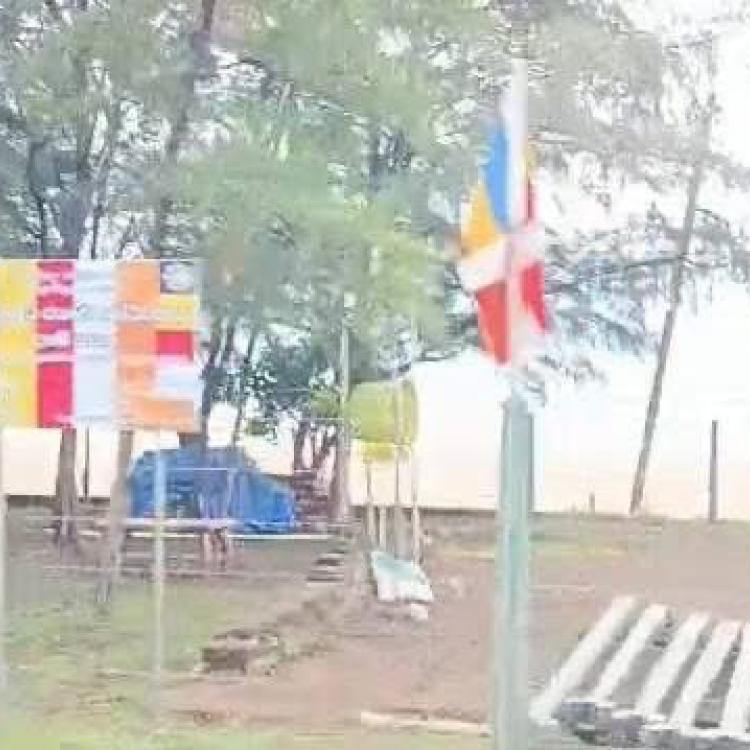
There has been outrage in Trincomalee after Sri Lankan police removed, then hastily reinstated, a Buddha statue placed without authorisation on a public beachfront, in an incident Tamil parliamentarians say has exposed the National People’s Power (NPP) government’s willingness to bend to Sinhala nationalist pressure.
The controversy began over the weekend when a group of Sinhala Buddhist monks arrived at the Trincomalee shoreline and began constructing a temple structure on the beach, a space long used by local residents and visitors. Coast Conservation officials filed a police complaint, stating that no permission had been granted for any religious construction at the site.
Video footage showed police officers attempting to stop the monks, but the confrontation quickly escalated. By nightfall, the police removed the Buddha statue that had been placed on the sand, briefly raising hopes among Tamil representatives that the authorities were finally prepared to enforce the law.
Those hopes lasted less than 12 hours.
Speaking in parliament this morning, Minister of Public Security Ananda Wijepala claimed the statue had been removed only due to a “threat of potential vandalism,” and that it had been returned to the site. He added that police protection would now be provided for the unauthorised shrine.
“We have issued a directive to the Police to place the statue at the Dhamma school today. A special security plan will also be implemented from today for the safety of the statue,” he said. The minister further claimed that the tense situation stemmed from a dispute over a restaurant in the area, rather than the illegal construction.
Journalists blocked
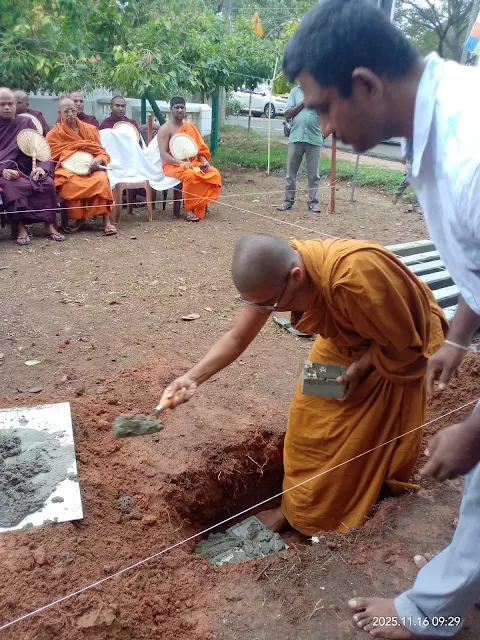
Earlier in Sunday, senior officials from the Department of Coast Conservation and Coastal Resource Management (DCC) and several journalists were forced out of the Sri Sambudda Jayanthi Bodhivardhana temple premises, after Buddhist monks at the site confronted them and prevented an inspection into the unauthorised building project.
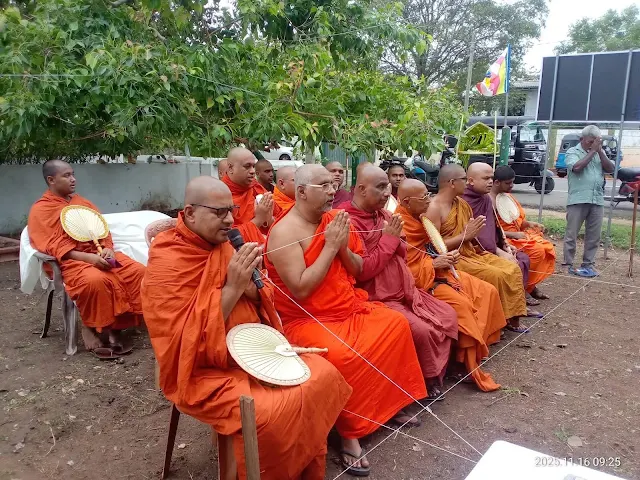
It came after reports of construction materials being transported into the temple premises late on 15 November. Journalists who accompanied the team were also verbally threatened and told to leave immediately.
Officials said the monks blocked all attempts to document or inspect the site. “They refused to allow any photographs, video, or even note-taking,” one official said after filing a police complaint.

Tamil politicians: Government has capitulated
Tamil parliamentarians immediately condemned the government’s reversal.
Ilankai Tamil Arasu Katchi (ITAK) MP Shanakiyan Rasamanickam, who had praised the police removal of the statue last night, said the minister’s latest comments revealed a complete capitulation.
“A major U-turn by the Public Security Minister this morning. He has walked back his earlier stance and now says the illegal temple will receive police protection, claiming the statue was removed only to prevent vandalism. It’s an embarrassing climbdown, and it’s obvious the minister and the government have given in to nationalist pressure,” he said on X.
Rasamanickam condemned the claim that Tamil residents posed a risk to the shrine.
“And let’s be honest. Tamil people have never destroyed religious shrines, not even during a 30-year war. Using ‘vandalism’ as an excuse is not just unconvincing, it’s an insult to a community that has always respected places of worship,” he added.
ITAK spokesperson M. A. Sumanthiran also condemned the government’s actions.
“The NPP government stands exposed as a racist, Sinhala Buddhist nationalist force, no different to any other government in the past,” he said.
He called for all Tamil MPs in the NPP, including Trincomalee MP Arun Hemachandra, to resign from the government.
A well-known pattern: state-enabled encroachment in the Tamil homeland
For decades, Sinhala Buddhist monks have held powerful influence over successive Sri Lankan administrations. Since the end of the armed conflict, state bodies such as the Archaeology Department, Forestry Department, and Wildlife Department have repeatedly facilitated the installation of new shrines across the Tamil homeland, even in areas with no Buddhist population or historical Buddhist presence.
From Mullaitivu to Batticaloa, Tamil villagers have documented numerous cases of monks attempting to seize land, erect statues, or claim sites as “heritage locations”, often with tacit or open backing from the military and state officials.
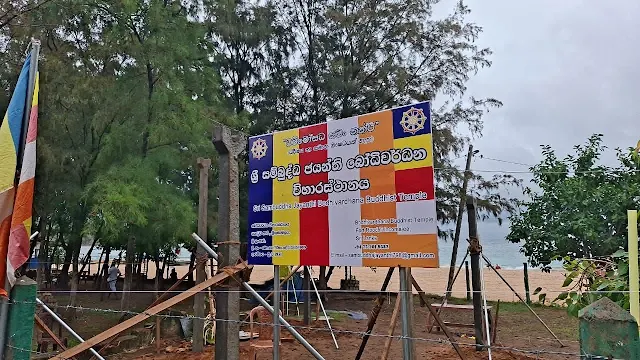
Yesterday’s incident follows a similar script. Police confirmed that the beachfront land is currently under a court order prohibiting development. The Coastal Conservation Department, which has legal authority over the area, stated that the monks had begun construction without any form of approval. Yet the minister’s public announcement now effectively grants police protection to an illegal encroachment.
A video circulating online shows a monk claiming the site is a religious heritage location, a justification frequently invoked by Sinhala nationalists during land-grabs in the North-East.
‘Feet of clay’: NPP rhetoric collapses
The NPP government has repeatedly claimed it would uphold equality before the law and challenge impunity. Tamil MPs say this episode demonstrates the opposite.
Sumanthiran wrote:
“Last night… some people actually thought that the government was acting properly without any racist mindset. Alas! That was short-lived… All their rhetoric of treating all the peoples equally fell flat on its face when the Minister unashamedly announced in Parliament that the statue was removed due to security concerns and that it will be reinstalled today.”
He added:
“This government’s feet are also made of clay.”
Trincomalee: a long-contested symbol of state-backed Sinhalisation
Trincomalee has been a focal point of Colombo’s Sinhalisation efforts for decades. The district is home to the ancient Koneswaran Temple, a site central to the Tamil nation, which has repeatedly faced encroachment by Sinhala nationalists and the military. Numerous Buddha statues and shrines have been constructed in the district since the 1980s, often on state land or protected coastal zones.
Tamil lawmakers say yesterday’s incident is part of the very same pattern: illegal encroachment, rapid political justification, and eventual state protection.
Rasamanickam stated:
“The NPP’s promise that no one is above the law clearly doesn’t seem to apply when Buddhist monks are involved.”
The NPP exposed
The reinstatement of the statue and new police protection effectively legitimise an unauthorised construction that began without permission on a public beach.
For Tamils, the incident is a clear sign that despite its anti-corruption rhetoric and promises of equality, the NPP government is unwilling to challenge Sinhala Buddhist nationalism.