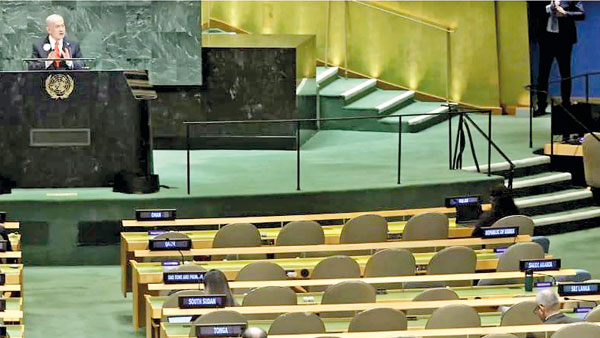
A Sri Lankan diplomat remained in the chamber of the United Nations General Assembly as dozens of delegates walked out in protest during a speech by Israeli Prime Minister Benjamin Netanyahu this week.
As Netanyahu took to the podium, representatives from across the globe left their seats, with large sections of the hall standing empty. Outside the UN, protesters gathered in Times Square, condemning Israel’s assault on Gaza.
While Sri Lanka has reiterated its support for the recognition of a Palestinian state, the government has been notably reluctant to criticise Israel directly for the ongoing genocide in Gaza. When the walkout occurred, it was initially unclear whether the Sri Lankan delegation had taken part or was absent from the chamber altogether.
Later footage, however, showed a single diplomat from Sri Lanka’s mission to the UN seated behind the country’s nameplate as Netanyahu delivered his address to a near-deserted assembly.
In his remarks, Netanyahu doubled down on rejecting the creation of a Palestinian state, declaring that “Israel will not allow a Palestinian state to exist” and claiming this stance was supported by the majority of Israelis.
The presence of a Sri Lankan diplomat in the chamber contrasts with the widespread boycott by other delegations, underscoring Colombo’s continued equivocation on Israel’s actions in Gaza even as the death toll mounts.
More than 60,000 Palestinians have been killed by Israeli forces in an assault that has increasingly been recognised internationally as a genocide. UN agencies and rights organisations have warned of mass starvation, the targeting of hospitals, and the systematic destruction of civilian infrastructure.
Sri Lanka continues to strengthen bilateral ties with Israel, even as global scrutiny over Israeli military actions intensifies. In recent months, Sri Lanka has sent hundreds of workers to Israel, including during the height of the bombardment of Gaza, drawing backlash from campaigners who argue that Colombo is enabling a state accused of genocide.
Successive Sri Lankan governments have maintained close ties with Israel, particularly around military and intelligence cooperation. Over the years, Sri Lanka has purchased Israeli weapons and sought Israeli expertise in counter-insurgency — especially during the massacres of Tamils in the North-East.
Tamil civil society and activists in the North-East have repeatedly drawn parallels between Israel’s assault on Gaza and Sri Lanka’s own atrocities at Mullivaikkal in 2009, emphasising the shared experience of mass civilian slaughter and the urgent need for international justice mechanisms.