
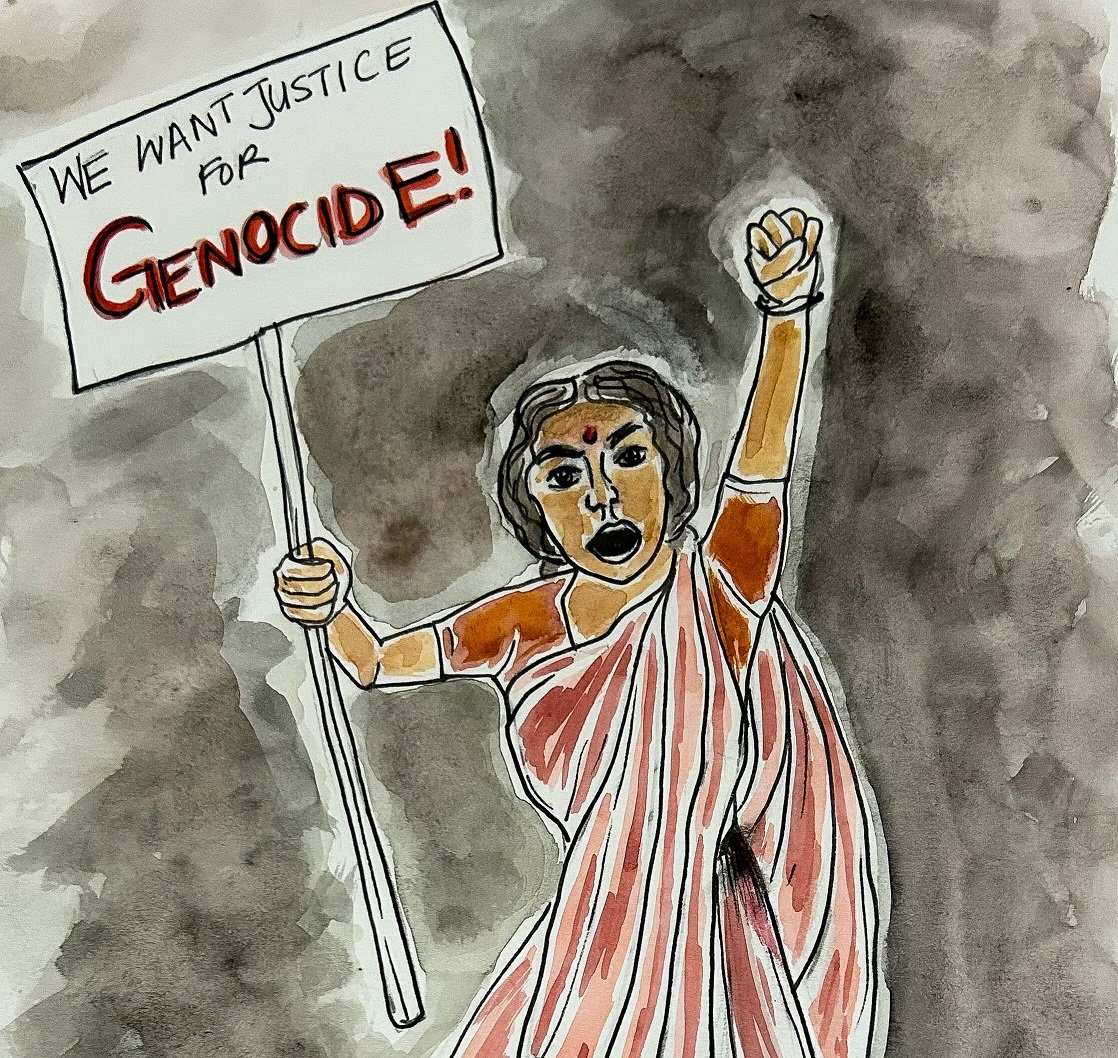
As Tamils reflected on yet another anniversary since the Mullivaikkal genocide, the frustration with the lack of justice for the massacres and progress towards a permanent solution to the ethnic conflict is familiar. What the last week has also demonstrated, however, is that there is a growing distance between the language of solidarity from those who claim to be allies in this pursuit, and the courage it actually requires. On the island and around the world, there is yet to be a reckoning.
At Mullivaikkal itself, on the very ground where thousands were slaughtered in the final days of May 2009, thousands gathered. They did not come to mark the end of a conflict or a particularly grave humanitarian crisis. They came to remember a genocide. Not only is that a universally accepted truth across the entire Tamil polity, it is what happened. A deliberate, systematic massacre, carried out with the intention to destroy the Tamil nation.
Human Rights Watch also attended the commemorations this year. Yet the NGO's Asia Director stood at that site, among those mourning tens of thousands of dead, and declined to use the word for which they had gathered. Worse still, she then called for a "domestic mechanism with a strong international component" — a formulation that directly contradicts what Tamil victims, civil society organisations, and political parties have consistently demanded for years. That is not solidarity, as she claimed. It is appropriation: attending the memorial, absorbing the moral gravity of the occasion, and then redirecting it toward a conclusion the victims themselves have explicitly rejected.
Her remarks are not an isolated lapse. In 2024, Amnesty International's Secretary General also visited Mullivaikkal. In 2025, UN Human Rights Chief Volker Türk visited the Chemmani mass graves and laid flowers at a memorial. The symbolism of presence matters, and we do not dismiss it entirely. But without acknowledgement of the victims' calls, it distorts Tamil suffering and risks becoming its own form of erasure. Not one of these institutions has named what occurred to the Tamil people as a genocide. They have stood alongside victims and witnessed first-hand the impact of these atrocities, while rejecting their most basic conclusions.
There is more than legal caution at play. These organisations have a tortured history when it comes to Eelam Tamils, and many carry a debt they have never acknowledged. The UN's own internal review found that UN staff suppressed or downplayed casualty figures, and that its conduct was a “systemic failure”. Amnesty International and Human Rights Watch documented abuses throughout the conflict, but neither organisation matched the urgency of what was happening with the urgency of their public demands. Their restraint, alongside sometimes fervent criticism of the Tamil resistance, gave diplomatic cover to a military campaign that was massacring civilians. Tamils have not forgotten this. The accusation of complicity - not malicious, perhaps, but structural - is not easily dismissed.
What makes the current posture harder to accept is the comparison that now imposes itself. When civilians are killed in Gaza, several of the same organisations have called it what it is. They have demonstrated that the institutional and legal barriers to using the word genocide are not, in fact, insurmountable when the political will exists. There is a glaring double standard between what is said about one people's suffering and what is withheld from another's.
This is precisely why the stance of Rev. Fr. Jeewantha Peiris deserves to be respected. The Sinhala Catholic priest last week meticulously detailed how the decades of killings of Tamils constituted a genocide, issuing a public call for greater recognition from the South. His remarks exposed the sharp divide that continues on the island, with Sri Lanka’s Catholic Church moving to distance themselves from his remarks, but over 100 Tamil priests and religious figures coming out to praise them. It demonstrated that a Sinhala voice can bear witness with clarity and without evasion, even at personal cost. That is what solidarity looks like. It is the standard by which others must now be measured.
His example must also prompt harder reflection from those who consider themselves allies closer to home. What does it mean to serve kanji in an act of commemoration in Colombo, while refusing to acknowledge why kanji was the only sustenance available to Tamils in the no-fire zones in the first place? If you cannot name what you are standing against, that is not solidarity.
The words of people like Fr. Peiris are what this moment requires, particularly as the Sri Lankan state continues on its current path. Anura Kumara Dissanayake attended a Victory Day ceremony, sitting alongside war criminals, openly praising the military and rebuffing calls for accountability. He is a man who came to office speaking of change. The NPP's abandonment of even the pretence of reform is now complete.
Meanwhile, genocide recognition continues to pick up pace in capitals around the world, with Canadian Prime Minister Mark Carney stating it was "an important step in acknowledging this painful history". A new memorial was opened in Sydney, with more planned around the world that will outlast every evasion from Colombo and from those who refuse to recognise the scale of Tamil suffering. The Tamil cause is not fading. It is internationalising.
The Tamil nation does not need institutions that visit graves, lay flowers, and then retreat to the language of diplomacy. It needs those who claim to stand for human rights to demonstrate that the principles they invoke apply universally and that Tamil lives matter. The people who were killed at Mullivaikkal, and those who survived it, are owed nothing less.
The question that now hangs over every institution that claims to want justice but declines to say the word is a simple one: how much longer?
_____
Illustration by Keera Ratnam / wavesofcolour