
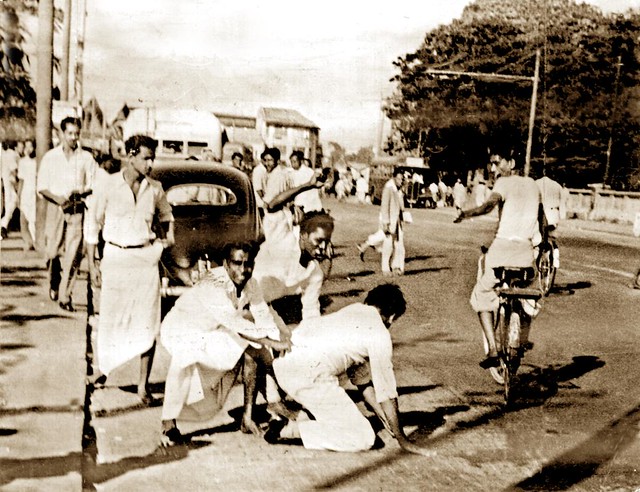
Photograph: A Sinhalese mob beats a Tamil passenger after pulling him out of his car. 1958. (Courtesy Victor Ivan)
This week marks 68 years since Sinhala mobs unleashed a wave of anti-Tamil violence across the island, in what became one of the deadliest anti-Tamil pogroms in Sri Lanka's post-independence history.
Beginning on 22 May 1958 and continuing into June, the violence left hundreds of Tamils dead, thousands displaced and entire communities traumatised. Estimates place the death toll at between 300 and 1,500 Tamils, whilst countless others were injured. Tamil homes, businesses and places of worship were looted and burned, women were subjected to sexual violence and thousands were forced to flee as refugees.
The pogrom erupted just two years after the island’s first ethnic based pogrom against Tamils in 1956 and followed escalating tensions surrounding the Sinhala Only Act, which had marginalised the Tamil language and intensified Sinhala-Buddhist nationalism across the island.
According to contemporary accounts, the violence began when Sinhala mobs attacked Tamils travelling through Polonnaruwa to attend the sixth convention of the Federal Party in Vavuniya. What followed was a rapid spread of violence across the island.
A Hindu priest was burnt alive in Colombo, whilst mobs roamed the streets of Colombo checking whether passers-by could read Sinhala newspapers. Those who could not were beaten or killed. The government waited five days before declaring an emergency.
On 27 May, after days of killings and unrest, the Sri Lankan state finally declared a state of emergency. By then, anti-Tamil violence had engulfed towns and cities across the island.
One of the most detailed contemporary accounts of the pogrom was provided by journalist Tarzie Vittachi in his landmark 1958 book Emergency '58: The Story of the Ceylon Race Riots.
Writing at the time, Vittachi challenged claims that the violence had erupted spontaneously. He recalled remarks attributed to the Governor-General:
"News trickled out from Queen’s House that the Governor-General had announced, off-the-record at a press conference, that the riots had not been spontaneous.
What he said was: ‘Gentlemen, if any of you have an idea that this was a spontaneous outburst of communalism, you can disabuse your minds of it. This is the work of a Master Mind who has been at the back of people who have planned this carefully and knew exactly what they were doing. It was a time-bomb set about two years ago which has now exploded.’"
As the violence spread, Vittachi documented how mobs targeted Tamils in public spaces and transport networks.
He wrote:
"Vehicles were stopped by the crowds who checked them for Tamil passengers. Tamils were pulled out forcibly and attacked."
Elsewhere, he described the brutality inflicted on victims:
"One Tamil lady had her ear lobes torn off because her attackers were in too much of a hurry to give her time to unscrew her ear-rings."
The violence was fuelled by rumours that spread rapidly through Sinhala-majority areas. Vittachi recounted how fabricated stories circulated across the island, inflaming tensions and encouraging further attacks.
According to his account, rumours falsely claimed that hundreds of Sinhalese had been massacred in Jaffna, despite police records showing that the peninsula had remained comparatively calm during the early stages of the violence.
Vittachi was particularly critical of the government's response. In one passage, he described a meeting on the morning of 27 May where civic leaders urged Prime Minister S. W. R. D. Bandaranaike to declare a state of emergency.
He wrote that those present were "appalled at the insouciance with which the Prime Minister appeared to be taking the mass murders, looting and lawlessness which had broken out everywhere in Ceylon".
Whilst politicians debated, Vittachi observed that "Colombo was on fire". He documented widespread looting and arson in Pettah, Maradana, Wellawatte, Ratmalana, Kurunegala, Panadura, Kalutara, Badulla, Galle, Matara and Weligama.
His book also highlighted broader concerns over the erosion of the rule of law. Vittachi argued that political interference had weakened policing and emboldened violent actors.
"The law and its arm, the police, were becoming increasingly hopeless and helpless at the time of the big strikes and the race-riots of May and June," he wrote.
The events of 1958 left a lasting mark on generations of Eelam Tamils, including LTTE leader Velupillai Prabhakaran.
See excerpts from a March 1984 interview with Prabhakaran below.
“The shocking events of the 1958 racial riots had a profound impact on me when I was a schoolboy. I heard of horrifying incidents of how our people had been mercilessly and brutally put to death by Sinhala racists. Once I met a widowed mother, a friend of my family, who related to me her agonising personal experience of this racial holocaust. During the riots a Sinhala mob attacked her house in Colombo. The rioters set fire to the house and murdered her husband. She and her children escaped with severe burn injuries. I was deeply shocked when I saw the scars on her body.
I also heard stories of how young babies were roasted alive in boiling tar. When I heard such stories of cruelty I felt a deep sense of sympathy and love for my people. A great passion overwhelmed me to redeem my people from this racist system. I strongly felt that armed struggle was the only way to confront a system which employs armed might against unarmed, innocent people."
For many Tamils, the pogrom marked a decisive turning point in relations between the Tamil nation and the Sinhala-dominated state. It reinforced a growing belief that successive governments were either unwilling or unable to protect Tamil lives and rights.
Vittachi himself ended his book with a warning that would resonate for decades to come.
"The broad picture is now complete. Race-relationships which had endured for generations were breaking up under the pressure which is inevitable in a country in which economic development had not kept pace with modern needs and the high rate of population increase. Labour relations were cracking under the strain of the new social forces which the MEP had released. This second change, no doubt, was necessary and irresistible.
Unfortunately the Government made the mistake of throwing the baby away with the bath water. While repressive legislation and irksome, outmoded attitudes which had kept the masses in thrall had to be hurled away without delay, it was vital for the peace and order of the country, especially in times of rapid social change, to preserve and strengthen the rule of law and the authority of the officers who enforce the law. This salutary rule was ignored and even spurned in the extravagant mood of enthusiasm in which the Government tried to meet the massive problems that challenged its capabilities.
The terror and the hate that the people of Ceylon experienced in May and June 1958 were the outcome of that fundamental error. What are we left with? A nation in ruins, some grim lessons which we cannot afford to forget and a momentous question: Have the Sinhalese and the Tamils reached the parting of the ways?"
The massacres of 1958 were followed by further anti-Tamil violence, including the pogroms of 1977 and 1983, the burning of the Jaffna Public Library in 1981, and ultimately the genocide at Mullivaikkal in 2009.