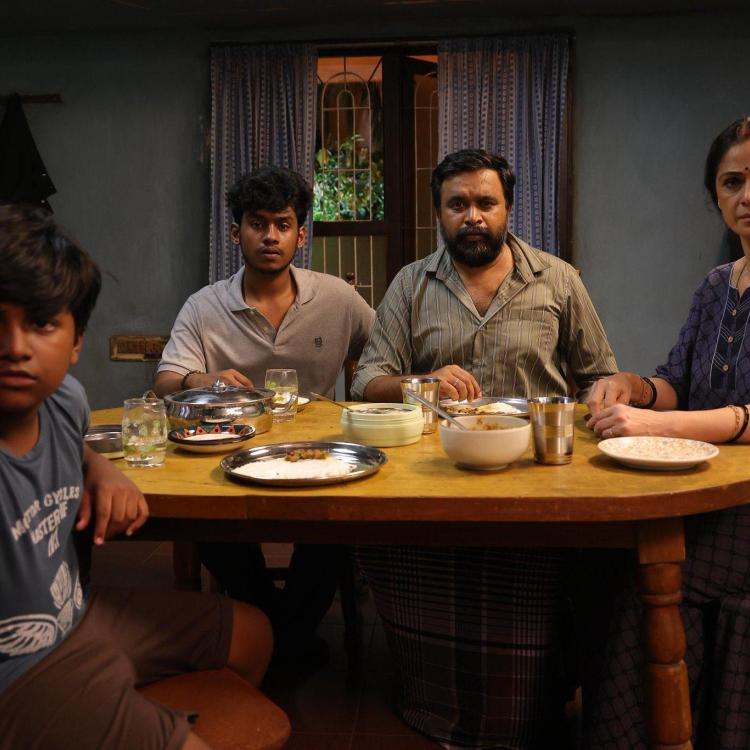

Tourist Family, a feel-good, family-friendly movie, was released worldwide last month and pulled massive numbers at the box office. The film, a directorial debut from Abishan Jeevinth, stars some of the Tamil film industry’s biggest names, including Simran and Sasikumar, in what has now become the highest-grossing film of his career.
Centred around an Eelam Tamil family fleeing the economic crisis in Sri Lanka, it has garnered mostly positive reviews, winning praise for its blend of comedy, teenage romance, and emotional drama. Given the heavyweight backing it received, there were high hopes that the sensitive subject matter would finally receive the deft and honest storytelling it deserves.
But the film, like so many other Kollywood films that have approached the Eelam Tamil story before it, falls disappointingly short. Instead of being an emotional, if light-hearted, telling of a plight that resonates deeply with many of its viewers, it ends up being a sanitised whitewash. It is yet another missed opportunity for Tamil cinema.
Where are the refugee camps?
The first and most glaring issue is the complete erasure of the struggles that Eelam Tamil refugees face in India.
The story of an Eelam family fleeing by boat to Tamil Nadu is not a new one. It is a lived reality that has taken place for decades and continues to this day. But, unlike the film’s protagonists, for the vast majority of those who have been identified by police, their fate lies in internment in one of Tamil Nadu’s many refugee camps. That the very mention of such camps or the suffering of their fellow refugees was never acknowledged, even in passing, demonstrates how out of touch the film’s story lies.
These camps are a brutal and dehumanising reality for many Eelam Tamils who arrive in India. To this day, tens of thousands remain trapped in them. According to a 2023 state government report, approximately 50,000 people continue to be interned in the camps and of that number, 79% have been stuck in them for over 30 years. Even those that were born in the camps cannot leave, with some 45% of the interned population born in India. So far, only one person has ever been granted citizenship and voted in an Indian election. One. And that single woman, who was born in India in 1986, remains in Kottapattu camp, with the rest of her family who continue to be denied citizenship.
.jpg)
Eelam Tamil refugees in India earlier this year spoke out at the neglect they faced in Tamil Nadu.
Beyond these camps, whilst the film nods to the challenges Eelam Tamils face in India, including suspicion, marginalisation, and discrimination, it does so fleetingly, with little depth or consequence. The racism that they endure daily, which shapes their access to education, employment, and citizenship, is glossed over in favour of sanitised, digestible moments, seemingly designed to comfort a domestic audience.
For all its warm storytelling, Tourist Family whitewashes the actual lived experiences of Eelam Tamil refugees in India.
Say the words
It wasn’t just the refugee camps, or the systemic discrimination faced by Eelam Tamils that were missing. The term “Tamil Eelam” itself is conspicuously absent. The characters are from “Sri Lanka,” from “Ilankai,” from “Ceylon” — from anywhere but Tamil Eelam. In trying to be ‘apolitical’, if there is such a thing when it comes to film, it dares not even utter the word “Eelam” at all.
This erasure is not incidental. Using the term should not be controversial, particularly in a film that is made for a Tamil audience. But to name Tamil Eelam would be to acknowledge the struggle for it, the genocide of those who fought for it, and the ongoing demand for self-determination. And that, for mainstream Indian cinema, remains disappointingly too inconvenient.
The Eelam Tamil accent
And finally, there is the accent. As the film itself acknowledges, the Eelam Tamil accent is distinct, shaped by centuries of unique history. But to native speakers, the forced inflections and pronunciations in the film were grating.
For a production with a considerable budget, why was not a single Eelam Tamil actor cast? The talent exists - yet Kollywood continues to overlook it in favour of commercial names. This may be forgiven for a few stars to draw in the masses at the box office, but when none of the cast are of Eelam heritage, the film quickly loses any sense of authenticity.
Tamil cinema’s paternalism
Tourist Family is not the first film to falter on this issue. Tamil cinema has a long history of mining the Eelam Tamil experience of war, displacement, and armed resistance for dramatic effect – from 2002’s Kannathil Muthamittal through to 2021’s Jagame Thandhiram. But in each attempt, the subjects are stripped of political context and viewed through a lens that can only be described as paternalistic at best, and wilfully ignorant at worst. Eelam Tamil suffering becomes an aesthetic device that sells cinema tickets, not a political or human reality.
In contrast, Eelam Tamil artists in the diaspora have consistently produced work grounded in lived experience. These works may lack the budgets and reach of Kollywood, but they carry a depth and truth that commercial films rarely achieve. Why is Tamil cinema unwilling to learn from or uplift these voices? Indeed, at a time when some Tamil films are daring to push the boundaries of progressive politics around caste, gender, and class, why does the entire industry handle Eelam Tamils and their stories so carelessly?
Much of this may be, understandably, due to fears of censorship from India’s strict Central Board of Film Certification (CBFC). Director Arun Matheswaran openly spoke of how his desire to make a film about the Tamil Eelam liberation struggle was halted due to fears that it would not get released. Instead, his 2024 film entitled Captain Miller, a clear homage to the LTTE’s first Black Tiger, had to be set “in the pre-independence era so that no questions would arise and there would be no controversy”.
Tourist Family may have faced those same obstacles. But the only way that they can ever be overcame is not by conforming, but by consistently challenging and speaking out against them. It is a shame that has not yet been the case.
That is also not to say every Eelam Tamil story needs to be one that is foregrounded in the conflict. There are many successful Eelam artistic projects today that may have little or even nothing to say about the refugee experience. But when a film so explicitly centralises its entire plot around Eelam refugees, it cannot be carved out and told in neatly packaged, guilt-free parts that ignore the difficult truths that come with it.
It is not as if the film wanted to steer away from any such heavy topics and maintain a light comedic tone throughout either. It does choose to tackle deeper, more emotional themes, but instead of talking about the plight of refugees, the film instead turns to the issue of dementia and its impact on a secondary character. It is a strange and awkward choice, both in the film’s continuity and its politics.
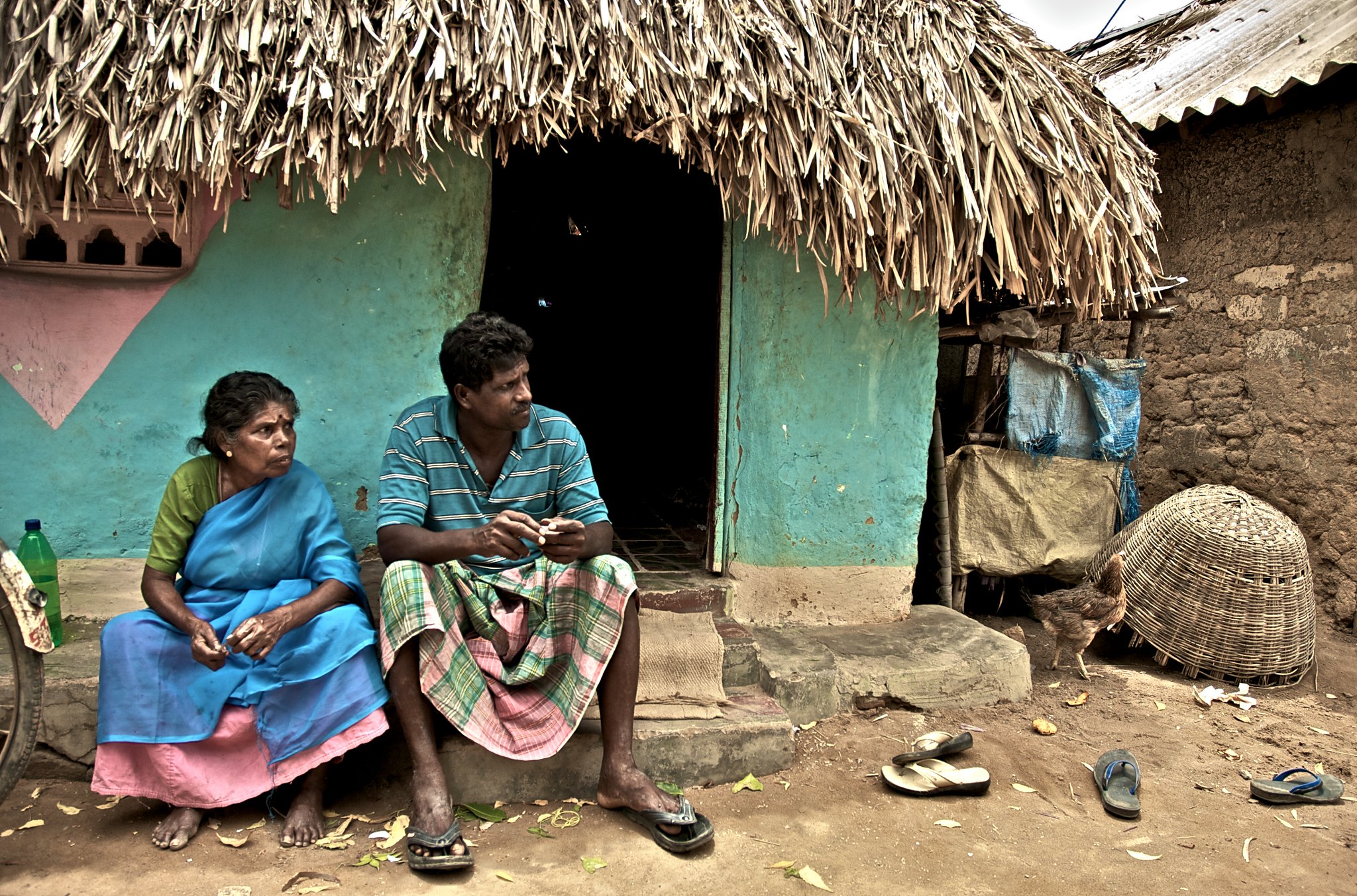
Eelam refugees in Tamil Nadu, 2012. Courtesy EC/ECHO Arjun Claire
A much bigger problem
Overall, the film’s flaws point to a larger issue, that is not just a Tourist Family problem, or even a Kollywood problem. It is a Tamil Nadu problem.
The broader issue lies in how Eelam Tamils continue to be perceived by the Tamil Nadu establishment and society at large – as objects of sympathy or charity, but never as political agents in their own right. It is not just in cinema. It is in wider Tamil Nadu society and in its politics. It is what allows politicians to wax eloquent about genocide and the courage of the Tamil armed resistance at public rallies yet do shockingly little to actually advance the Eelam cause. It is a shallowness in solidarity that is sadly deeply entrenched.
None of this is to argue that the film was made with malicious intent. In all likelihood, it is a sympathetic tale that was meant to comfort and to uplift.
But who exactly is being comforted?
Not the fictional Tourist Family, who even at the seemingly ‘happy ending’ of the film, will continue to live a life shrouded in fear of capture by the authorities. They do not end up receiving citizenship or the security of knowing they will not face the threat of internment or deportation.
And certainly, there is no comfort for the tens of thousands of real-life tourist families still languishing in camps. Nor for the countless Eelam Tamils who are still looking to flee the island.
Good intentions alone, are not enough.