
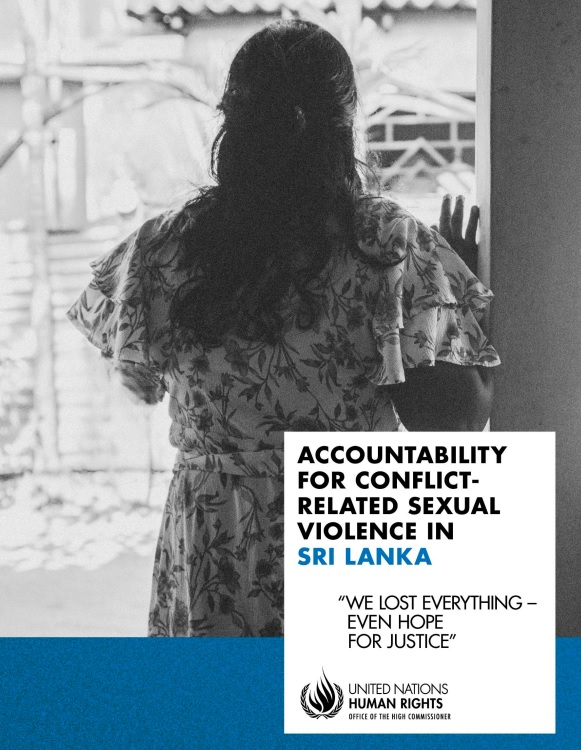
A new report issued by the Office of the United Nations High Commissioner for Human Rights (OHCHR) has laid bare the widespread and systematic use of conflict-related sexual violence by Sri Lankan state forces, alongside decades of entrenched impunity that continue to deny justice to Tamil survivors.
Titled “We Lost Everything – Even Hope for Justice: Accountability for Conflict-Related Sexual Violence in Sri Lanka”, the report builds on more than a decade of UN investigations and survivor consultations, documenting how sexual violence was used by the Sri Lankan state as a deliberate tool of torture, intimidation and social control during and after the armed conflict.
The OHCHR concludes that these violations were not isolated acts but formed part of a “widespread and systemic pattern”. The report states that sexual violence was employed “as a strategic tool to extract information, assert dominance, intimidate individuals and communities, and instill a pervasive climate of fear and humiliation”.
“Such violations were institutionally enabled,” it added.
Despite the extensive documentation of these crimes, successive Sri Lankan governments have failed to investigate or prosecute perpetrators. The report notes that official denial and minimisation of violations have reinforced a culture of impunity, leaving survivors without justice, reparations or meaningful acknowledgment.
It also notes that "sexual violence is prohibited under different and complementary legal frameworks: international human rights law (IHRL),53 international humanitarian law (IHL), and international criminal law (ICL). It constitutes a grave violation of international law and may amount to war crimes, crimes against humanity, or acts of genocide".
Survivors consulted by OHCHR described enduring trauma, stigma and fear, compounded by continued militarisation of the Tamil homeland. One survivor told OHCHR that the ongoing presence of military camps and monuments in civilian areas “remind them of the crimes they endured, symbols of pain, not justice”.
The report documents sexual violence committed by Sri Lankan security forces, including the army, navy, air force, Criminal Investigation Department, Terrorism Investigation Division, Special Task Force and affiliated paramilitary groups such as the Eelam People’s Democratic Party (EPDP). Victims were overwhelmingly targeted because of their Tamil identity or alleged links to Tamil resistance.
“The cruelty of the abuses inflicted – including mutilation, exposure, public degradation - was often described by the survivors as being intended to cause lasting trauma and dismantle entire communities,” the report noted. Many survivors believed that the abuses were designed not only to harm the individual, but to terrorize the entire Tamil nation with the intent of destroying their social fabric.
One survivor stated: “They cut off the genitals of men to put them in women’s mouths... chopped one woman into pieces.”
A former LTTE cadre described: “The women cadres were already dead. Their bodies had been hanging in the trees naked... The soldiers inserted sharp blades and rods. Metal parts were coming out of the body.”
A female survivor testified: “I was no longer treated as a human being, as a woman - but worse than an animal.”
Survivors testified that these acts were intended to dismantle the community’s dignity and collectively dehumanize them: “Such violent acts were carried out to take out the dignity of the Tamil community. These are crimes against the community. The community needs to hear the truth and to receive an acknowledgment of the crimes. They need to hear what allowed Sri Lanka to commit these crimes and dehumanize an entire community”
OHCHR highlights that men were as likely as women to be victims, yet male survivors remain particularly silenced due to stigma and discriminatory laws that fail to recognise male rape. Survivors recounted rape, gang rape, sexual torture, forced nudity, genital mutilation and sexual humiliation, often carried out in detention centres, checkpoints and homes.
One survivor stated, “It gives the message that nothing really happened. It keeps the crime alive.”
Another warned against treating these cases as isolated, saying, “The world heard about Isaipriya but there are thousands of Isaipriya… There are so many stories that are still untold.”
The report also details the profound failures of Sri Lanka’s domestic justice system. Survivors described being humiliated by police, pressured not to file complaints, subjected to language barriers in court, and retraumatised during proceedings. One survivor’s representative recalled a woman being asked in open court to display torn undergarments, describing the experience as “like raping her again”.
Prosecutions remain exceedingly rare. Of dozens of documented cases involving security forces, most suspects were discharged, acquitted or released on bail. In emblematic cases such as Kumarapuram and Vishvamadu, convictions were later overturned, while command responsibility was never pursued. The Attorney General’s unchecked discretion has allowed politically sensitive cases to be quietly dropped.
The report further highlights Sri Lanka’s failure to provide reparations. None of the survivors consulted had received compensation, rehabilitation or official acknowledgment. One survivor told OHCHR, “We lost everything, our husbands, kids, and dignity. No one can give that back. All we have is this suffering.”
While the current government has made public commitments to justice reform, OHCHR states that “tangible progress remains to be seen”. Sixteen years after the end of the armed conflict, impunity for conflict-related sexual violence remains firmly entrenched in the Tamil homeland.
The report calls for survivor-centred accountability mechanisms, independent investigations, reparations and guarantees of non-recurrence.
It also urges the international community to move beyond expressions of concern and support concrete pathways to justice, including the use of universal jurisdiction and international accountability processes.
Read the full text of the report here.