
.jpeg)
Photograph by Priya Tharmaseelan
When Sunthar V stepped onto the stage at Massey Hall, it marked a defining moment.
“Massey is a historic venue which meant a lot to me, to join so many legends in not only playing it but selling it out. Most of it on the first weekend of the announcement. Producing and financing it independently is also pretty much unheard of.”
For the Tamil Canadian, it was a highlight of his comedic career - one that has already seen him perform in venues across the globe. His path to that Massey Hall however, a renowned 2,700-seat theatre in downtown Toronto, began far more modestly. “My first gig in 2018 was at a little Tamil owned pub thats now closed,” he recalls.
Yet the significance of this show, he says, was never just about personal success.
“It was about elevating Eelam Tamil community art to an unprecedented level without hand outs, without connections or appeasing anyone,” he told the Tamil Guardian.
“January 30 2009 Tamil Canadians made headlines for creating a human chain just steps away from the same venue.”
“It was probably one of the few times we made headlines in Canada and it wasn’t in a compassionate or positive light. I remember feeling a sense of shame for something I shouldn’t have felt shame for. It left a deep scar for me and how I show up as a Tamil-Canadian in Canada. This show was a reclamation for myself and so many felt that.”
For Sunthar, the night was also about pushing forward new paths and possibilities. “For a community that has endured so much yet continues to thrive across industries, politics and academia; our ability to find commercial success in art has been stunted significantly. I wanted Massey to make history but also to inspire the artist in our community to know that it is possible.”
“Artists have to live parallel lives and are often taken advantage of promoters and management companies.”
The comedian’s social media pesona and viral reels have already amassed him a significant following. Remarkably, he has been able to translate that into real live performances. “I don’t have the largest number of followers online,” he says modestly. “But I fill out rooms that many with a lot more would struggle to. I’m never take for granted the people who support me or the opportunities to constantly stand for the things they also feel.”
“I think it speaks to how valuable creating for community is.”
That commitment to community is also evident in his collaboration with fellow Tamil Canadian comedian Mithusha, known as Me2Chat. The two first connected during the pandemic.
“After coming across Mithusha’s content in lockdown we became connected online. I knew that her wit and perspectives were meant for bigger things. I asked her to open for me when I did a small show in Montreal. She did the gig and swore off stand up. But with encouragement and coaching she’s quickly becoming a superstar. I’m like a proud comedy Appa. I can’t wait to see the incredible things she achieves.”
.jpeg)
Photograph by Thulasi Jothiravi
As an openly queer Tamil comic, Sunthar has opened new doors for many and has been quick to try and share the limelight. Through comedy clubs set up in London and New York, he has already introduced nearly 100 budding comics to new audiences.
“I think artists can often get caught up in ego and the “crab” mentality,” he says, as he talks about his passion for uplifting others.
“The more of us there are, the more opportunities and space we can take up. I’m excited for the future of Eelam Tamil artists and how a generation after me will continue to grow to heights beyond me.”
His chemistry with Mithusha on stage, he says, comes from both shared experience and difference. “We’re of two generations but our thinking is so similar. We’re both endrenched in Tamil culture and community. Our parents yell at us the same, we have the same questions about the world but we also have different perspectives on a lot of things.”
“I think the mix of similarities and differences makes our bond and our on stage chemistry strong. We also are appeal to a wider audience together bridging generations of our own and beyond.”
On the night itself, Massey Hall felt transformed. We asked him, what was it like?
“Unreal but also exactly the feeling I expected.”
“When you build something over time down to the little details like kuthuvizhakkus and silverware on stage it executes and people enjoy it - it’s the ultimate validation.”
.jpeg)
Photograph by Thulasi Jothiravi
It was more of a community gathering, than a show, he says, describing the crowd as deeply personal.
“I love performing in Toronto and London because they are both cities who have been apart of the real life journey, not just the online hype. They’ve seen me on my fire nights and my not so funny nights. Seeing faces I hadn’t seen in ages from primary school to even some of my former non-Tamil banking colleagues it was the ultimate oor thiruvizha to quote my Amma.”
It was actually the first show that his parents were attending, adding to the history of the moment. So for the show itself, Sunthar made a bold creative decision.
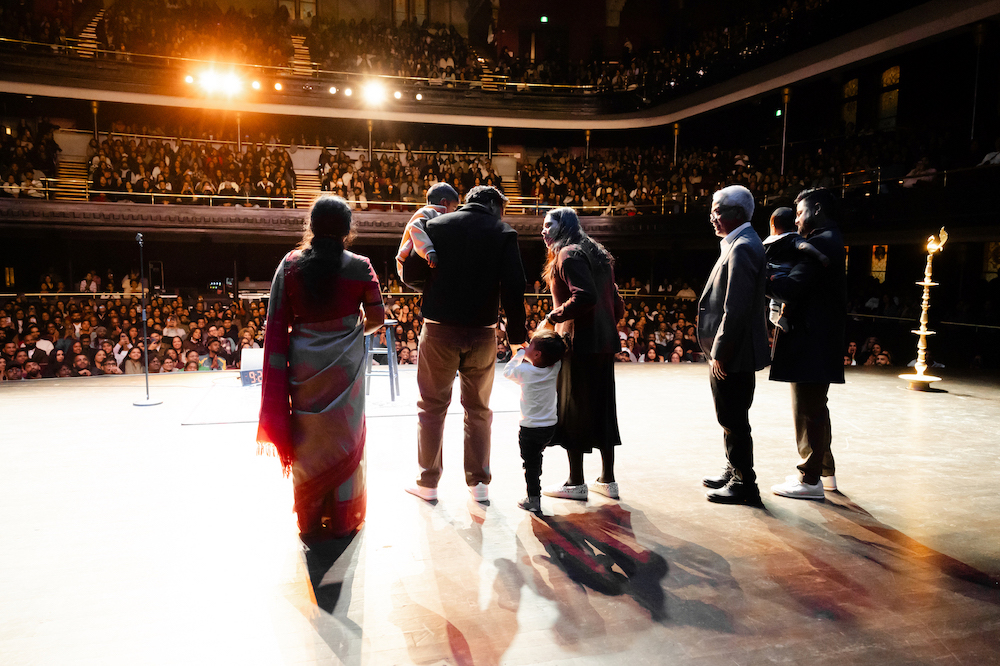
Photograph by Priya Tharmaseelan
“I pulled a bit of a risky move last minute by dropping most of my tried and tested tour material for a new set focused on the moment and how we got there. Seeing the venue in person, I felt the moment demanded a more reflective story telling experience for me… I wanted the gravitas of Canadian Tamil history to be held in light.”
It was a move that worked, resonating deeply with his audience. “I think that surprised a lot of people as it was a bit of a departure from my usual routine. However many reached out to tell me how much that deeply moved them the nod to our histories, our shared trauma of a diaspora impacted by genocide and the resilience with which our parents instilled our language and culture; the very reasons they had to leave.”
He is equally proud of Mithusha’s performance. “Mithusha’s set was the mark of her arrival as a global superstar. I’m so proud of how she’s found her voice, cadence, and fast paced performance style. For many who’ve seen her content online, this was the first time seeing her live and command a room. I think it left most wanting more and rest assured this is just the beginning.”
For Sunthar, the impact of the night goes beyond external recognition and shifting how Tamil culture is perceived in the wider Canadian arts scene. “It also more importantly shifts how Tamil diaspora receives and showcases Tamil culture within our community,” he adds.
“Our art is made by us, for us. If it appeals to a wider audience than that it obviously is a plus, but there is power and satisfaction of creating for community in a world where art is only valued when it’s commercially mainstream or has the endorsement of South Indian celebrities.”
That distinction is important, he notes, adding that he sees growing curiosity beyond the Eelam Tamils. “I recently did a show in Atlanta where I just took Q& for a good hour with mostly South Indian audience who was curious about the Eelam Tamil diaspora history and experience.”
Tamil identity remains central to his work.
“It’s quite frankly everything,” he tells us. “It’s authentically how my brain thinks and what I love most doing. The use of Tamil language is also important to me. Though most of my material is in English, switching to say things in Tamil adds nuance only the oldest language in the world has.”
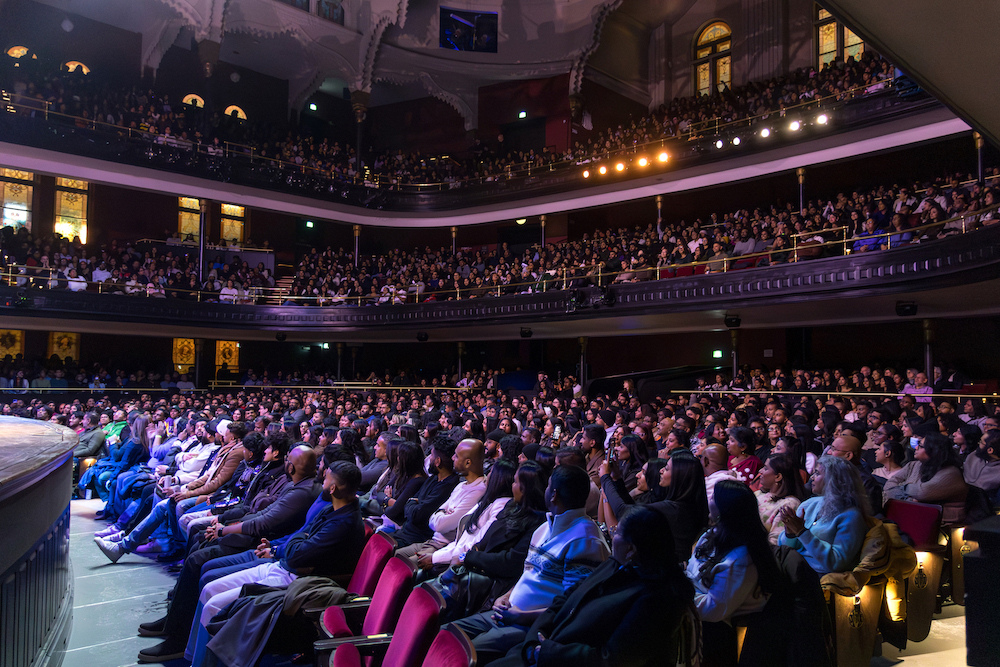
Photograph by Sabajanan Sabeesan
Yet, Sunthar has still managed to navigate humour that resonates with both Tamil audiences and wider Canadian audiences without diluting the Tamil voice. He rejects the idea of having to ‘tone down’ Tamil references or political themes in order to appeal to mainstream audiences.
“Bring independent means doing whatever I want,” he says. “I hope that I never lose that as things grow. As an Eelam Tamil and as an openly queer person, I can’t be myself without a political context. I spent nearly 30 years in the closet, I don’t need to do it in my artwork too.”
He is clear about his direction. “There are many non-political comics to chose from and they may even be more commercially viable but I want to be able to remain a strong voice for community, as well as let history be my guide in all that I do.”
That independence has required discipline and learning a lot more management. “Artists have long been taken advantage by producers and even other artists. From my very first show, I knew that if I had to succeed at the scale I am at now I’d have to know the business inside out. Knowing how much things cost the way venues and promoters operate the market demands marketing tactics are all fundamental to an artist’s success today.”
If that sounds like a lot of work for a single artist, then it probably is. But it has paid off. “I don’t make huge amounts of money but I’ve been able to live off my art for 4 years with many sacrifices, and the help of friends family,” he adds.
“I credit understanding the business and never letting anyone disrespect my value. I’ve been asked to promote multimillion dollar budget shows for free, and as tempted as I was to work with some big names, I had to stand my ground.”
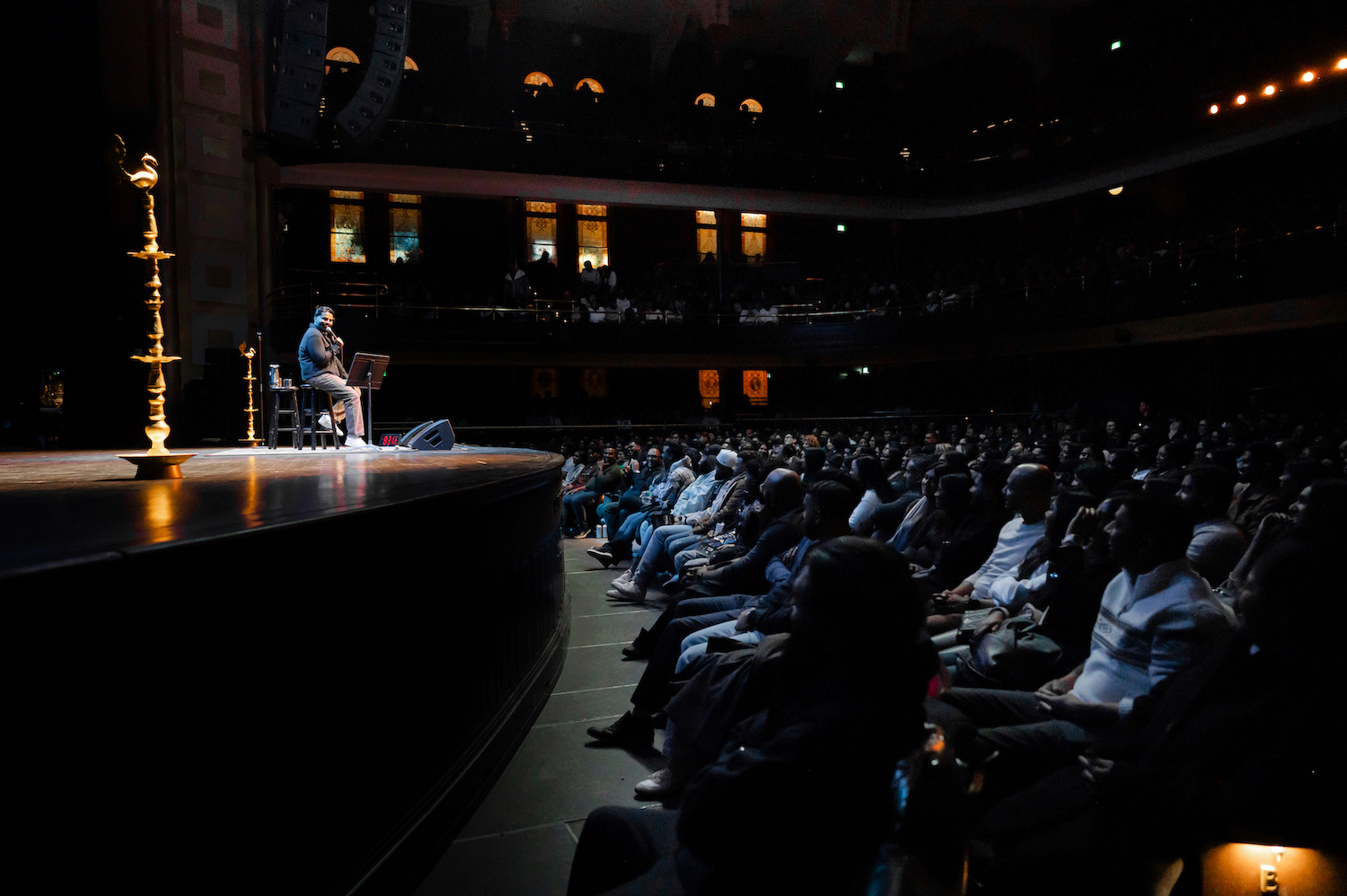
Photograph by Sabajanan Sabeesan
For younger creatives, his advice is grounded.
“Harness the power of community and treat yourself like a business. Provide value be authentic and as in life, treat others how you want to be treated. Go where the energy is and never stop learning or exploring new ways of doing things. Don’t get caught up in online numbers. I don’t have huge numbers relative to a lot of touring comics but I’ve been selling out shows for 4 years.”
Looking ahead, the ambition is clear. “I want to grow Tamil comedy to levels only Kollywood music touring has achieved,” he says. “Whether that’s me or someone who I’ve coached it’ll be a collective achievement for community.”
For now, the memory of Massey Hall remains deeply personal. “I can’t ever stop thanking my community for the love they give me. I think my parents being at Massey to see the standing ovation and hear from strangers how impactful my work has been is a core memory that little Sunthar never could have imagined.”
“To make my people laugh and experience joy while accepting all of me is an indescribable blessing many don’t achieve in a lifetime. It almost feels spiritual.”