

A copy of the reparations report was submitted to Sri Lankan officials.
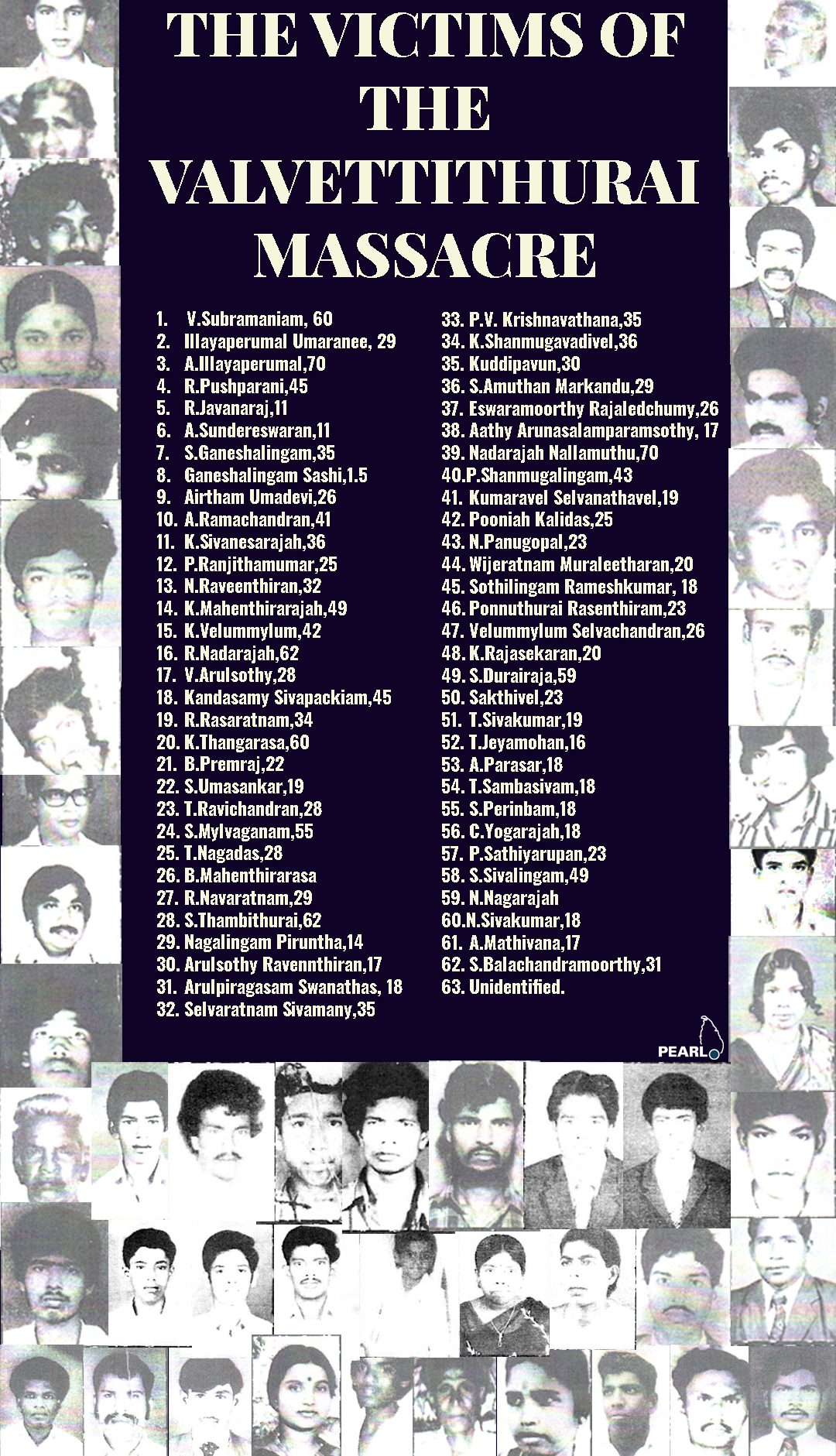
For the first time in Sri Lanka’s history, a detailed reparations and compensation claim has been submitted by victims of a historic mass atrocity, the 1989 Valvettithurai massacre, in which at least 66 Tamil civilians were killed and 34 injured by the Indian Peace Keeping Force (IPKF).
The claim, amounting to Rs. 4.5 billion (USD $15 million), was developed by the International Truth and Justice Project (ITJP) in collaboration with the Valvettithurai Citizens’ Committee and submitted to the Sri Lankan Office for Reparations. It marks a significant step in seeking long-overdue justice for one of the most devastating massacres of the armed conflict.
The ITJP report, which accompanied the claim, sets out a detailed financial assessment of losses sustained by victims, their families, and the community at large. Compensation has been calculated for loss of life, injuries, and property destruction, as well as accrued interest over the past 35 years.
According to the findings, the 66 individuals killed in the massacre are owed Rs. 29.7 million, while Rs. 1.38 million is due to the 36 who were injured. Damages to homes, shops, and fishing equipment total Rs. 57.5 million, bringing the combined sum to Rs. 88.7 million at 1989 value. When adjusted for interest from August 1989 to May 2025, the total rises to Rs. 4.5 billion.
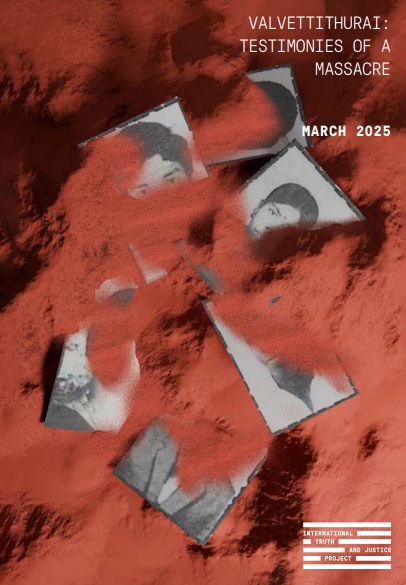
The reparations report was formally released on Sunday in Vadamarachchi at an event organised by the Valvettithurai Citizens’ Committee, alongside the local launch of the book “Valvettithurai: Testimonies of a Massacre.” The first copy of the publication was presented to Vincent De Paul Douglas, Chairman of the Point Pedro Urban Council, by Committee Secretary N. Anandaraj, who also unveiled the compensation report.
The ceremony opened with tributes to those who were killed, with the father of a fallen Tamil liberation fighter, Mr. Sundaralingam, lighting the ceremonial flame. Candles were lit and floral tributes offered in remembrance of the victims.
Attendees included former parliamentarian M. A. Sumanthiran, local councillors, traders’ associations, journalists, and survivors of the massacre, many of whom had lost family members and property during the IPKF’s three-day assault on the coastal town.
The Valvettithurai massacre, carried out by Indian forces deployed under the 1987 Indo-Lanka Accord, saw entire neighbourhoods destroyed, with 123 houses and 43 shops burnt, and over 250 others damaged. Eyewitness affidavits from 1989 documented widespread killings, torture, and looting. Despite the wealth of testimony, there has been no accountability or redress for the victims in the 35 years since.
In its submission, the ITJP structured the reparations claim according to internationally recognised principles of justice, including restitution of property, rehabilitation through psychosocial support, formal acknowledgment from the Government of India, and guarantees of non-repetition through legal and institutional reform.
“This is not just about monetary compensation,” a spokesperson for the Valvettithurai Citizens’ Committee said. “This is about truth, justice, and dignity for our community. Reparations are a right, not a favour.”
While the claim was formally submitted to the Sri Lankan government, the Citizens’ Committee stressed that ultimate responsibility lies with the Government of India, under whose command the IPKF operated. They called for a public apology from India for the harm inflicted on Tamil civilians.
ITJP Executive Director Yasmin Sooka described the claim as a landmark step, stating that “it sets a precedent for other communities to demand justice where states have failed them.”
The report also noted that the current compensation claim does not include reparations for psychological trauma, torture, or the long-term displacement of survivors — all of which require comprehensive inclusion in any future reparations programme.
For the families of Valvettithurai, many of whom continue to live in the shadow of loss and state neglect, the claim represents both a demand for justice and a call to remember a chapter of history that remains unacknowledged.
‘India’s My Lai’
The Indian Peace Keeping Force was deployed in the North-East in 1987 under the Indo-Lanka Accord, ostensibly to enforce peace between the Sri Lankan state and the Liberation Tigers of Tamil Eelam (LTTE). Instead, it became implicated in widespread atrocities against Tamil civilians, including killings, disappearances, and sexual violence.
The massacre in Valvettithurai, the hometown of LTTE leader Velupillai Prabhakaran, remains one of the most infamous of these atrocities. For decades, survivors and Tamil civil society groups have demanded truth, accountability, and reparations, yet neither the Indian nor Sri Lankan governments have acknowledged responsibility.
The ITJP’s report marks the first time a community-led compensation claim has been formally calculated and submitted for a historic atrocity in Sri Lanka’s history.