.jpg)
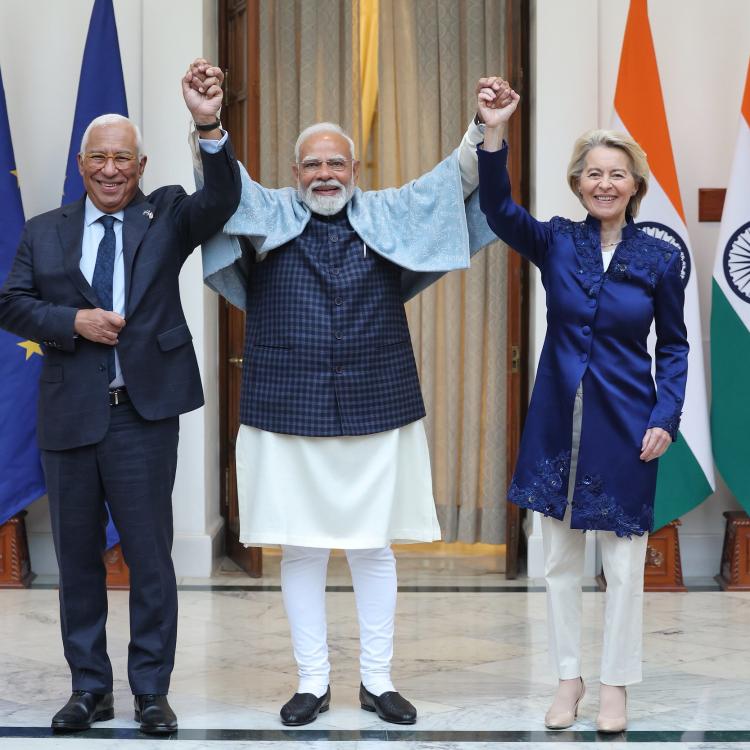
Indian Prime Minister Narendra Modi with President of the European Council, Antonio Costa & President of the European Commission, Ursula von der Leyen
The landmark free trade agreement announced between India and the European Union, hailed by both sides as “the mother of all deals”, is set to redraw regional trade dynamics in South Asia and beyond. While New Delhi and Brussels have framed the agreement as a historic partnership covering nearly a quarter of global GDP, the implications for Sri Lanka are far more troubling, with risks of Colombo being further marginalised within an already fragile economic landscape.
The deal, concluded after nearly two decades of intermittent negotiations, establishes a vast free trade zone encompassing around two billion people, accounting for roughly 25 percent of global gross domestic product. It will dramatically reduce tariffs on a wide range of goods and services, deepen supply chain integration, and strengthen investment flows between India and the EU. For India, the agreement promises preferential access for exports, while the EU will benefit from sweeping tariff reductions.
For Sri Lanka, however, the agreement threatens to intensify competitive pressures in precisely those sectors on which the island has long depended for foreign exchange earnings.
Erosion of Sri Lanka’s export competitiveness
Sri Lanka’s economy remains heavily reliant on exports to European markets, particularly garments, seafood, rubber-based products, and selected agricultural goods.
In 2024, Sri Lanka’s total exports stood at approximately USD 12.1 billion, of which exports to the European Union accounted for around USD 2.9 billion, representing nearly 24 percent of total export earnings. Any shift in European sourcing patterns therefore carries substantial consequences.
Under the new agreement, India will receive preferential access on roughly 97 percent of tariff lines, covering approximately 99.5 percent of its export value to the EU. Around 70.4 percent of tariff lines will receive immediate duty-free access, with a further 20.3 percent liberalised over a three to five year period.
This effectively removes tariff barriers that had previously constrained Indian exporters relative to competitors such as Sri Lanka. As a result, EU buyers are expected to gain access to lower-cost Indian goods across a wide range of sectors, intensifying price competition and threatening to displace Sri Lankan suppliers.
The risk is most acute in labour-intensive industries. Textiles and apparel remain the backbone of Sri Lanka’s export economy, accounting for over 50 percent of total export earnings and employing approximately 15 percent of the national workforce. These sectors directly overlap with Indian exports that will now enjoy enhanced tariff-free access into Europe.
Leather, footwear, tea, spices, and certain marine products are also identified as areas of moderate to high exposure, where Indian producers may undercut Sri Lankan exporters on price. India’s scale, manufacturing capacity, and ability to rapidly comply with EU regulatory standards further compounds this risk.
Sri Lankan exporters may find themselves at a significant disadvantage. This is particularly acute given Sri Lanka’s previous loss of the EU’s Generalised Scheme of Preferences Plus (GSP+) benefits in the past. The India–EU agreement effectively provides New Delhi with trade privileges that Colombo currently lacks.
Investment diversion and regional imbalance
Beyond trade in goods, the agreement is also expected to reshape investment flows. By positioning India as a stable, large-scale manufacturing and services hub with preferential access to a European market valued at approximately €22 trillion, the deal may divert foreign direct investment away from smaller regional economies such as Sri Lanka.
European firms seeking to restructure supply chains amid global uncertainty may increasingly prioritise India over Sri Lanka, particularly given India’s expanding infrastructure, energy connectivity projects, and deepening strategic alignment with the EU.
This poses longer-term challenges for Sri Lanka, particularly in the absence of large-scale industrial policy, export diversification, or meaningful trade negotiations of its own with the EU. For Colombo, which has struggled to attract sustained investment due to political instability, debt distress, and policy inconsistency, this shift could further limit growth prospects.
Strategic consequences for Sri Lanka
The deal also carries broader geopolitical implications. Both India and the EU have framed the agreement as a response to economic coercion and global instability, particularly in the context of trade tensions with the United States. Sri Lanka, by contrast, remains largely a rule-taker in this emerging order, lacking the leverage or economic resilience to shape regional trade frameworks.
As India consolidates its position as the EU’s primary partner in South Asia, Sri Lanka risks being relegated to the periphery, increasingly dependent on bilateral concessions rather than structural integration. This imbalance is likely to reinforce existing patterns of dependency and vulnerability within the island’s economy.
A warning sign for Colombo
The India–EU trade agreement serves as a stark reminder of Sri Lanka’s deteriorating position in regional and global trade. While neighbouring economies move towards large-scale, strategic partnerships, Sri Lanka remains constrained by unresolved debt, limited industrial diversification, and the absence of a coherent long-term trade strategy.
The consequences of being excluded from such mega-deals may be severe.
For Sri Lanka, the “mother of all trade deals” may ultimately become a symbol of deepening marginalisation in a rapidly transforming global economy.