
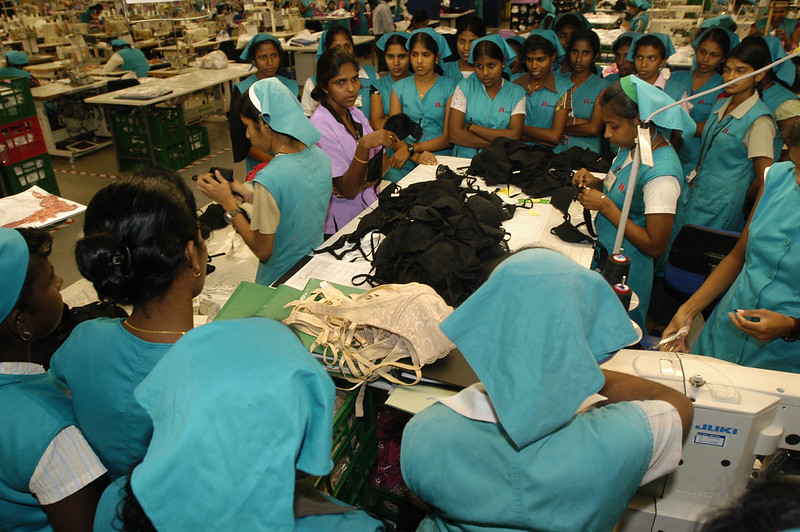
(Photo of Sri Lankan Garment Workers, Credit ILO Asia-Pacific)
Sri Lanka has been targeted by the Office of the United States Trade Representative (USTR), which has proposed new tariffs on imports from countries it says have failed to impose and effectively enforce prohibitions on goods produced with forced labour.
Under the proposed measures, Sri Lankan exports to the United States would be subject to an additional 12.5 per cent duty, placing the island among the countries facing the highest tariff rate under the initiative.
The move could have significant implications for Sri Lanka's export sector, particularly the apparel industry, at a time when the country is attempting to strengthen foreign exchange earnings and sustain economic recovery under an International Monetary Fund-backed reform programme.
The proposal follows a determination by the USTR under Section 301 of the US Trade Act of 1974 that the acts, policies and practices of 60 economies relating to the failure to prohibit and prevent the importation of goods produced with forced labour are "unreasonable" and place burdens on US commerce.
Announcing the findings, United States Trade Representative Jamieson Greer said:
"The failure of our most important trading partners to address the importation of goods made with forced labor is unacceptable. This creates a dynamic where American workers are forced to compete globally on an unlevel playing field."
"We will no longer tolerate this disparity. Some trading partners have taken initial steps to prevent the importation of forced labor goods, including through USMCA and commitments in Agreements on Reciprocal Trade. However, each of our trading partners must do more to ensure that trade does not perversely encourage and entrench forced labor globally."
According to the USTR, 54 economies, including Sri Lanka, were found to have failed both to impose and effectively enforce prohibitions on the importation of goods produced with forced labour. The list also includes China, India, Japan, South Korea, Australia, the United Kingdom, Brazil, South Africa and several other major US trading partners.
A further six economies, including Canada, Mexico, Pakistan, Indonesia, Ecuador and the European Union, were cited for failing to effectively enforce existing prohibitions. Those economies would face a lower additional tariff rate of 10 per cent.
Sri Lanka falls into the higher 12.5 per cent category because, according to the USTR determination, it has neither imposed nor effectively enforced a prohibition on imports linked to forced labour.
The USTR has also proposed a special textile mechanism that would allow a limited volume of apparel and textile imports from certain economies to enter the United States at reduced tariff rates. Further details are expected to emerge during the consultation process.
The announcement has prompted concern from Sri Lanka's business community, particularly given the country's dependence on the US market.
The United States remains Sri Lanka's largest single export destination and is especially important for the apparel sector, which accounts for a substantial share of export earnings and employment.
Responding to the proposal, the Ceylon Chamber of Commerce urged the Sri Lankan government to engage with Washington at the highest levels and seek urgent clarification regarding the basis for the proposed tariff.
"The imposition of an additional tariff on Sri Lankan exports risks undermining the competitiveness of key export sectors compared to other countries, which are at a lower rate of 10%," the Chamber said.
"At a time when Sri Lanka is working to accelerate export growth, attract investment, and create employment opportunities, any increase in trade barriers presents a significant challenge."
The Chamber noted that Sri Lanka was already engaged in discussions with the United States following the suspension of previously announced reciprocal tariffs and was seeking a more favourable long-term trading arrangement.
Business leaders warned that the proposed tariff would place Sri Lankan exporters at a competitive disadvantage relative to countries facing the lower 10 per cent rate.
The concern comes as several key Sri Lankan export industries are already under pressure. Apparel exports declined by 7 per cent during the first four months of 2026, whilst tea exports fell by 6 per cent over the same period.
The Chamber argued that Sri Lanka had developed a reputation as a responsible sourcing destination, with industries adhering to recognised labour, environmental and governance standards.
Against that backdrop, it called on the government to challenge the proposed classification.
"The Ceylon Chamber therefore requests the relevant authorities to engage proactively and at the highest levels with the United States to better understand the basis for the tariff and to present Sri Lanka’s case."
The organisation further stressed that every effort should be made to secure a reduction in the proposed duty and ultimately achieve its removal.
"Given the importance of the US market to Sri Lankan exports, timely engagement and clear communication on the way forward will be critical in providing confidence to exporters and investors."
The Chamber added that it stood ready to work with the government and other stakeholders to safeguard Sri Lanka's export competitiveness and long-term economic interests.
The USTR has invited public comments on the proposed measures, with written submissions due by 6 July 2026. Public hearings are scheduled for 7 July, whilst requests to appear before the hearings must be submitted by 22 June.
The outcome of the consultation process could prove significant for Sri Lanka's economic outlook. As Colombo continues to rely on exports, foreign investment and external financing to support recovery from its 2022 economic collapse, any deterioration in access to the US market could affect export growth, investment decisions and employment across several sectors.