
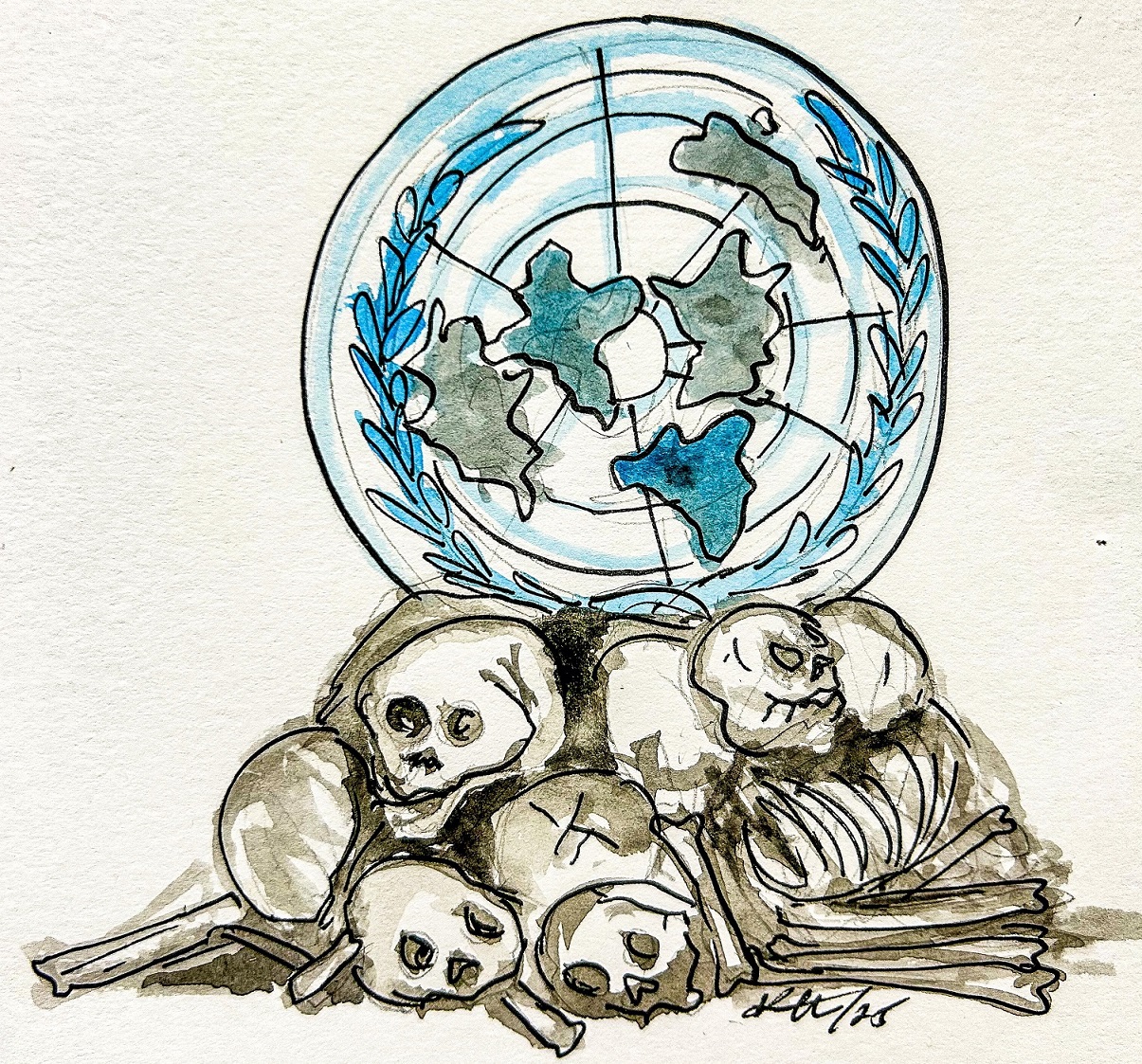
Last week, a much awaited new report from the Office of the United Nations High Commissioner for Human Rights (OHCHR) was released. For many, the document made for familiar reading. The report was damning in its findings. But its conclusion, was starkly weak, once again placing the onus on Sri Lanka to do what it never will – hold war criminals to account and deliver justice for mass atrocities.
The report was clear in its description of the situation on the island. “Impunity remains entrenched” it declared. “Meaningful and comprehensive security sector reform is yet to take place”. Human rights defenders and Tamil families of the disappeared continue to be harassed and intimidated. Land disputes continue, as does the military occupation. At least 49 arrests were made under the Prevention of Terrorism Act (PTA) this year alone, despite the ruling National People’s Power (NPP) regime’s pledge to abolish the law. And it acknowledged that this government has refused to co-operate with the OHCHR-established Sri Lanka Accountability Project, as well as continued to reject accountability-related resolutions at the Human Rights Council.
Yet, despite this devastating assessment, the report’s conclusion collapses into the same hollow prescription that has failed victims for decades. It simply urges Colombo to “consider the creation of a judicial mechanism” to prosecute violations of international humanitarian law. The very state that committed the crimes is, once again, invited to investigate itself.
This is not the first time victims have been told to pin their hopes on Colombo-led mechanisms. For decades, Sri Lanka has announced one sham process after another; from the Lessons Learnt and Reconciliation Commission (LLRC), to the Paranagama Commission, to the Office on Missing Persons (OMP). All of these have either faded into irrelevance or been weaponised to whitewash state crimes. Each has been a stalling tactic, designed to buy time, placate international pressure, and further entrench the very same impunity the report warns of. The idea that yet another domestic process could deliver justice is a naïve and deliberate ignoring of historical record.
Volker Türk’s insistence that such a domestic process can only be “complemented and supported by international means” is far removed from what victims and survivors have consistently demanded. Only an independent, fully international, accountability mechanism will suffice. Sri Lanka has proven itself unwilling and incapable of delivering justice. The international community must lead, not follow.
The only purportedly positive note the High Commissioner seems willing to cite from Colombo is a single, platitudinous remark from Sri Lanka’s president Anura Kumara Dissanayake that “all communities” had suffered during the war - a line as insulting to Tamil victims as it was devoid of substance. Indeed, just days later, his foreign minister, Vijitha Herath, threatened to arrest those who even use the word “genocide.”
It bears repeating what is at stake. The crimes committed by the Sri Lankan state were not minor infractions that require small-scale reform. They were mass atrocities: the deliberate shelling of hospitals and food distribution lines; the siege of hundreds of thousands; the summary execution of surrendering cadres and civilians; the enforced disappearance of tens of thousands; and widespread, systematic sexual violence. These are not crimes that can be papered over with vague gestures of “reconciliation” or empty promises of “truth-seeking”. They demand prosecutions at the highest level for genocide, war crimes, and crimes against humanity.
This regime has already shown it is not a break from the past. Türk claimed that there was an “opportunity” with Sri Lankan “leadership pledging a fresh direction”. But there is nothing fresh about the state of Sri Lanka, or indeed in this report. This very same report could have been published any time in the last decade and the exact same points would ring true. The pattern of entrenched impunity, empty promises, and international inaction remains the same.
Almost a year into the Dissanayake regime, any “opportunity” that the High Commissioner clings to has already passed. The self-styled “leftist” NPP continues to block any path to justice. The military still occupies Tamil land. Security forces still surveil and intimidate. And Tamils still end up arrested, tortured, or killed.
If the UN is serious about breaking this cycle, it must abandon the fiction that Colombo can or will prosecute its own war criminals. For Tamils, there is no justice in waiting for Colombo to prosecute itself. The window for reform within Sri Lanka was slammed shut long ago. The only path forward is one that bypasses the Sri Lankan state entirely through international prosecutions, universal jurisdiction cases, and a concerted global effort to hold perpetrators to account.
The Tamil people have waited long enough. Every new report that recycles the same condemnations but ends in the same weak appeals to Colombo is another betrayal. Justice will not come from the perpetrators. It must be delivered despite them.
_____
Illustration by Keera Ratnam.