
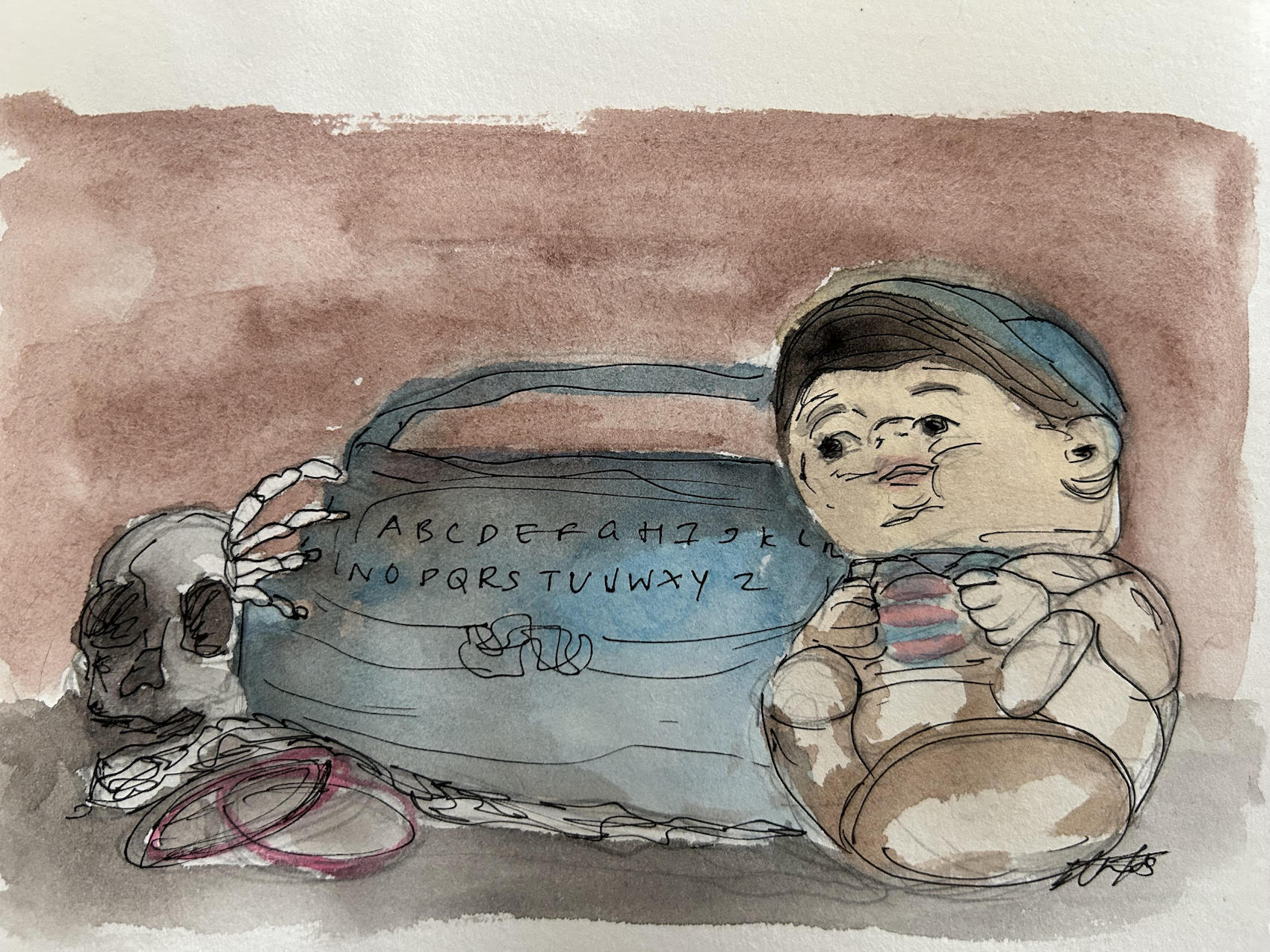
The discoveries emerging from the Chemmani mass grave over the past week have been harrowing. A blue UNICEF-issued schoolbag. A child’s toy. A sandal. And the bodies of men, women, and children, painfully unearthed one by one. Each one is a testimony to Sri Lanka’s brutal past and the enduring failure to bring those responsible to justice.
The existence of these grisly mass graves is no secret. Countless Tamils were murdered by the Sri Lankan state and buried in such sites. From Mirusuvil to Mullivaikkal, the Tamil homeland is marked by mass graves and militarised occupation. Chemmani, in particular, has been internationally recognised as a crime scene since 1998. Now, decades later, as yet another Sri Lankan regime attempts to present itself as a departure from its predecessors, the site is once again being excavated.
Yet the state’s response has been predictably muted. While the current administration launches high-profile crackdowns on alleged corruption and detains political opponents, it has done nothing to address matters of urgent importance to the Tamil people. There has been no acknowledgement of the concerns of families of the disappeared. The same state institutions that facilitated impunity are now tasked with supervising exhumations. The same military that stands accused of mass killings continues to occupy the North-East. And the party in power has adopted the same refusal to deliver meaningful international accountability as those before it.
What is happening at Chemmani stands in stark contrast to how the world has responded elsewhere. In Bosnia and Rwanda, the excavation of mass graves was accompanied by international justice mechanisms, forensic documentation, and, ultimately, prosecutions. In Sri Lanka, the very state accused of atrocity remains in charge of the crime scene. Tamils are right to ask - why are their dead not treated the same?
There are growing fears that this excavation will follow the same path as in 1999, where Colombo obfuscated, delayed, and ultimately sidelined the entire issue. This is why international intervention is imperative. There must be independent forensic oversight, international expertise, and victim-centred consultations. The process must be transparent, protected, and entirely free from the influence of the very institutions implicated in the killings. To treat Chemmani as anything less than a site of atrocity is to fail its victims once again.
Disappointingly, the international response so far has been too cautious. While the visit of UN High Commissioner for Human Rights Volker Türk to Chemmani was welcome, his statements in Colombo were far too soft for the gravity of what he had just witnessed. The moment called for urgency, clarity, and explicit action. What followed instead was understatement and fears of further appeasement. In Geneva, he must be far more forthright.
Some voices, however, are starting to speak. In recent weeks, several British MPs and a member of the US Congress have raised Chemmani and called for action. Tamils in the diaspora are mobilising, protesting, and lobbying. That momentum must now translate into tangible steps including support for international justice mechanisms and targeted sanctions on perpetrators of atrocities.
For far too long, the Tamil people have been told to wait for justice. For the mothers of the disappeared, the wait has already lasted too many lifetimes. Chemmani cannot be treated as another grim headline in a cycle of impunity. It must be a turning point. The evidence is there, in the soil of Jaffna. The world must no longer pretend it does not see.
_________________
Illustration by Keera Ratnam.