The Jaffna Magistrate’s Court has ordered that the third phase of excavation at the Chemmani mass grave will commence on 20 April, as investigations into one of the most significant mass burial sites in the Tamil homeland continue.
The case was taken up for hearing last week before Magistrate S. Leninkumar, who issued a series of directives aimed at preparing the site for renewed excavation work.
The court instructed the Nallur Pradeshiya Sabha to carry out cleaning activities around the mass grave for two days each week, under the direct supervision of the Judicial Medical Officer. The order is intended to ensure proper conditions for forensic examination as the investigation progresses.
It was also noted that temporary structures previously set up for workers and storage at the site had been damaged by Cyclone Ditwah and subsequent monsoon rains in Jaffna. The court ordered that these be removed and replaced with new sheds. The Nallur Pradeshiya Sabha was further directed to provide the necessary furniture and logistical arrangements, as had been done during earlier excavation phases.
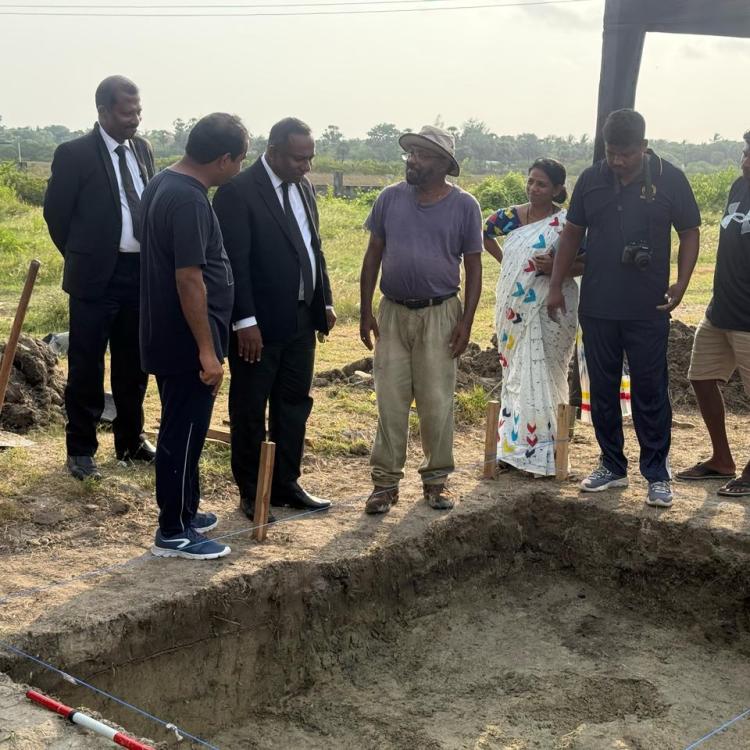
Following the hearing, Magistrate Leninkumar, Judicial Medical Officer S. Pranavan, attorneys including Niranjan and Ranitha, and officials from the Nallur Pradeshiya Sabha visited the site. During the inspection, it was observed that water remains stagnant in the burial pit.
The court accordingly set out a timeline for preparatory work. Water is to be drained on 28 March under the supervision of the Judicial Medical Officer. The case will next be taken up on 8 April, with the third phase of excavation scheduled to begin on 20 April.
The Chemmani mass grave has long been linked to the enforced disappearances and extrajudicial killings of Tamils carried out by the Sri Lankan military during the late 1990s. The site first came to international attention after testimony by a Sri Lankan soldier who had raped and killed a Tamil schoolgirl, revealed that hundreds of Tamil civilians had been buried in mass graves in the Chemmani area.
Initial excavations carried out in the late 1990s led to the recovery of a limited number of skeletal remains, but calls for a comprehensive investigation continued for decades, led by families of the disappeared and human rights advocates.
Excavation work resumed in recent years following renewed legal proceedings after more bodies were uncovered. Over the past year, multiple phases of excavation have been carried out, with more than 200 bodies, including that of infants, excavated so far.
These excavations have taken place in stages, with each phase requiring court approval, site preparation and forensic oversight.
The ongoing investigation is being closely monitored by families of the forcibly disappeared, many of whom have spent decades seeking answers about the fate of their loved ones. The Chemmani site has come to symbolise the broader struggle for truth and accountability in the Tamil homeland, where allegations of mass graves remain unresolved.