
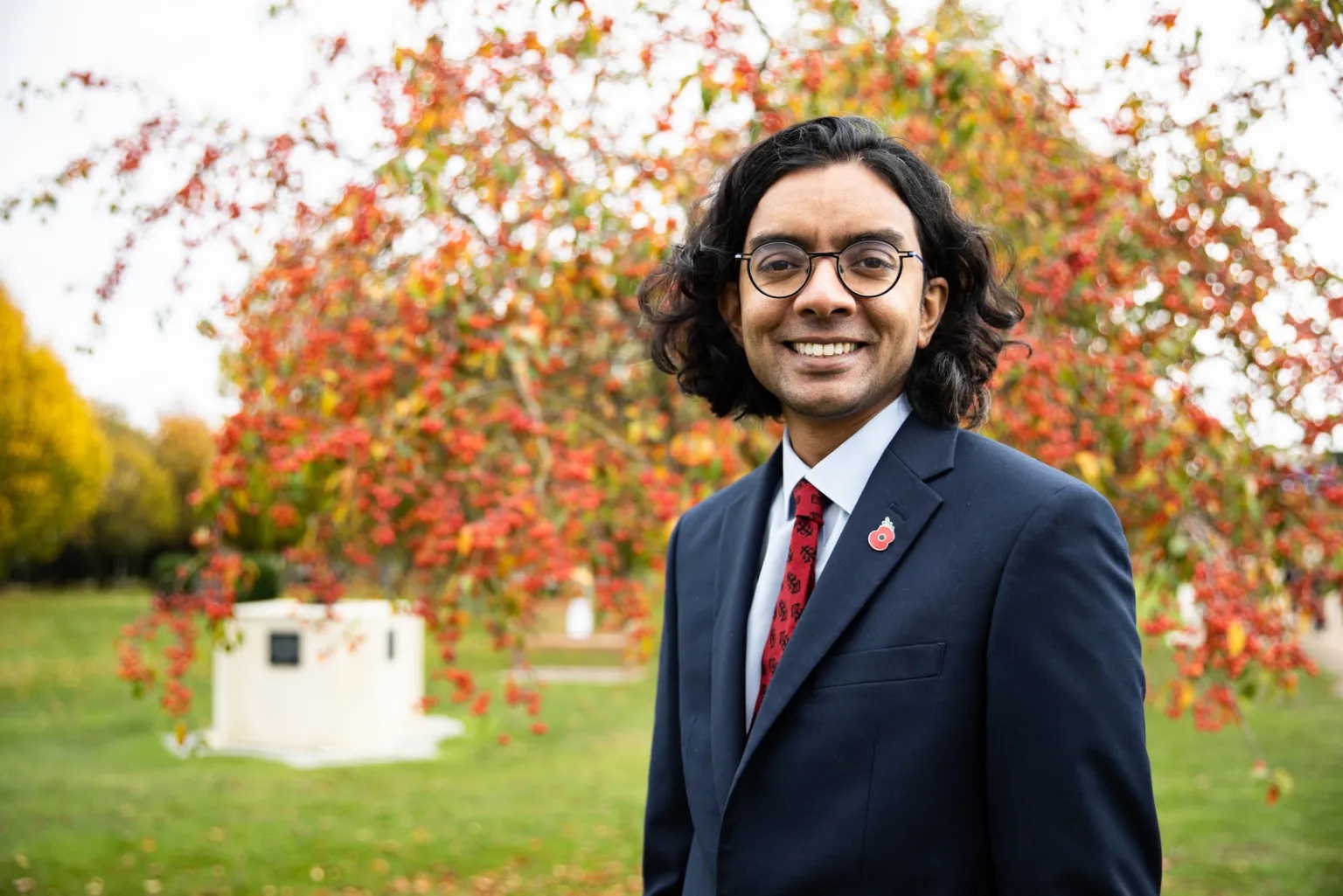
A British Tamil poet’s work was chosen by the Royal Family for this year’s Armistice Day commemorations, with his specially commissioned sonnet read at the national service attended by the Princess of Wales.
Arji Manuelpillai, poet-in-residence at the National Memorial Arboretum, was selected to write the official Armistice Day poem for the ceremony in Staffordshire, where Catherine, Princess of Wales, joined veterans, families and members of the armed forces for the UK’s central commemoration.
At exactly 11:00 GMT, the Last Post sounded across the Arboretum to mark the national two-minute silence observed each year on the anniversary of the end of the First World War.
The service featured the reading of Manuelpillai’s poem, A Sonnet For Us All, commissioned by the Arboretum and endorsed by Kensington Palace. The poem reflects the human relationships and emotional histories behind the hundreds of memorials located across the site.
“A Sonnet For Us All captures the stories etched into the hundreds of memorials within the National Memorial Arboretum, it invites people to listen, reflect and consider the emotion that was the inspiration for these sculptures,” Manuelpillai said.
“I hope these words shine a light on the bonds and relationships that lay often hidden by conflict. Those quiet acts of care, the friendships that endure, and the sense of duty that binds one generation to the next.”
Kensington Palace said the themes explored in the sonnet are “particularly close to The Princess’ heart”.
Manuelpillai is a widely recognised poet, performer and creative facilitator. A former Jerwood/Arvon mentee, his work has been shortlisted for the Burning Eye Pamphlet Prize, the Oxford Prize, the Wolves Poetry Prize and the Live Canon Prize, and he was runner-up for the Robert Graves Prize in 2020.
Read the full sonnet below.
'A Sonnet For Us All'
Arji Manuelpillai
'When you speak of our country, do not speak of war.
Speak of the nurse who held a hand like her own father's,
A lieutenant who embraced a soldier like his own brother.
Remember, sometimes those who go into burning buildings burn brighter than the fire inside.
Those who rise from burning buildings carry scars we cannot see.
If you speak of this country speak of the widow who never stopped waiting, the sailor who kissed a photo till it turned to ash in his hands,
or the pilots who meet in the pub to talk of anything but war
You see love is a compass, love is a bugle mourning.
Love is sacrificing tomorrow so that a stranger can live today.
So when you speak of this country, do not think of it as a place.
Think of it as a feeling, the feeling of being loved, the duty to pass that love to whoever needs it.'