
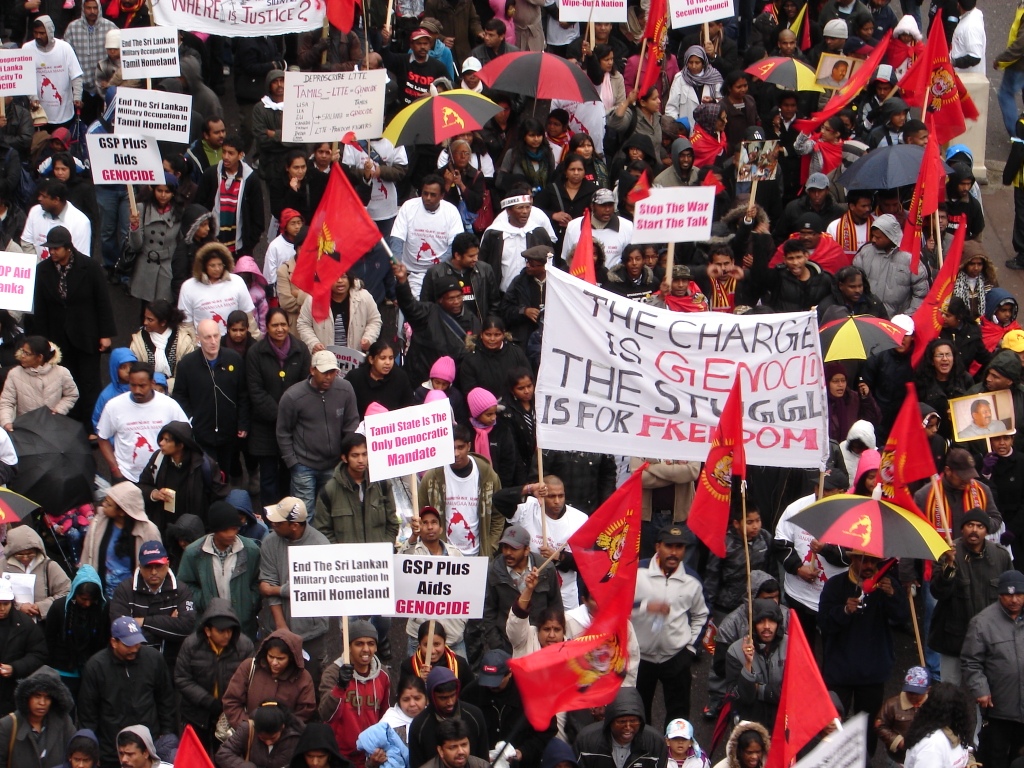
British Tamils protesting in London, 2009.
High profile resignations, a US$1 billion lawsuit from the President of the United States, and a global storm of outrage. Controversy has engulfed the world’s oldest national broadcaster this week, after a complaint was raised over a BBC Panorama documentary first broadcast last year, in which clips from a speech by US President Donald Trump were misleadingly edited together. The crisis is being slated as graver than ever before. It has sparked heated discussions around the BBC’s future and a piercing question that strikes at the heart of the matter – does the British Broadcasting Corporation suffer from systemic editorial bias?
Donald Trump and other right-wing political voices certainly think so. The Times highlighted both its coverage of transsexual rights and BBC Arabic’s reporting on the Middle East as examples. Editing the 12-second clip of Trump’s speech, which was brought up in a leaked dossier compiled by former external adviser Michael Prescott, seems to have been the straw that broke the camel’s back. It led to the resignations of BBC director-general Tim Davie and head of news Deborah Turness, as well as calls for apologies and even a threatened lawsuit.
Those who lean politically left, however, see the BBC in an entirely different light. They argue the institution has long reflected establishment and conservative viewpoints. From its hostile reporting on Jeremy Corbyn’s leadership of the Labour Party to its skewed coverage of Israel’s genocide in Gaza, critics say the most trusted news service in the world consistently amplifies right-wing talking points rather than scrutinising the entire political spectrum.
For British Tamils, this argument over editorial bias is not unfamiliar. During the genocide of 2009, they repeatedly demonstrated outside the BBC’s headquarters, demanding that the atrocities unfolding in the Vanni be reported accurately. At the time, it was one of the most horrific massacres of the 21st century. Hospitals and civilian ‘No Fire Zones’ were repeatedly bombed by the Sri Lankan military, in what several UN reports would confirm as systematic human rights violations. Yet the BBC’s coverage was muted, caveated and reluctant to name perpetrators. Sri Lankan narratives were repeatedly favoured, whilst eyewitness testimonies from Tamils were ignored almost entirely.
Even when hundreds of thousands of British Tamils took to the streets in one of the largest and longest-running demonstrations in modern British history, the BBC offered sparse and often dismissive coverage. Mothers pushing prams and pensioners with walking sticks blocked roads around Parliament, in unprecedented and iconic scenes of protest. Parliament Square was effectively occupied for months. And a British Tamil running for European Parliament secured the highest number of votes ever for an independent candidate. Nevertheless, it was all deemed unworthy of the coverage it deserved by the editorial board at the corporation.
Many have drawn parallels between that silence and the BBC’s present coverage of Israel’s genocide in Gaza. One study, for example, found that Israeli deaths received more than thirty times the coverage of Palestinian ones. Yet this raises an important question. How does a broadcaster that appears instinctively sympathetic to Israel, and which once echoed Sri Lanka’s narratives during the massacres in the Tamil homeland, simultaneously produce an unflattering and deceptive edit of Trump?
On this, several things can be true at once. Britain’s national broadcaster may indeed take a hostile approach to figures like Trump in Washington while also offering tacit support to states such as Israel and Sri Lanka. Far from being contradictory, these positions reflect a coherent worldview: one that prioritises the preservation of Western power, its allies and the neoliberal order that underpins it.
This is not a new political philosophy that guides the BBC, but a longstanding belief that runs through much of the Western media. There is firm support for establishment figures and institutions that propagate a certain brand of neoliberal politics. It is a structural bias that British Tamils know all too well. For decades, coverage of the Tamil liberation movement, like many other independence struggles around the globe, has been distorted and even vilified. They are deemed too disruptive of the status quo and the global order that Western institutions have sought to build for decades – one that backs Western-aligned nation states, suppresses self-determination struggles within them and even endorses genocidal violence when expedient.
British Tamils protested outside the BBC in 2009, just as they did outside the Houses of Parliament, precisely because they understood the structural forces shaping their people’s suffering. At the time, those dissenting voices may have been easier to dismiss. Now, with that very same bias is facing push back from figures such as the current President of the United States of America it is impossible to do so. After all, Donald Trump has deemed himself a disruptor of the political establishment. His movement’s hostility towards international institutions, his attacks on the current global order, and even his rejection of technocrats, directly challenge the BBC’s ideological foundations. His brash brand of populism has already cultivated a base in the UK - a brief glance at GB News for example, illustrates this succinctly. This week, those who seek to replicate Trump’s xenophobic politics in the UK have seized on the controversy with zeal, attacking the corporation relentlessly, using the crisis to push for a radical realignment of Britain’s media landscape.
The Guardian reported a BBC source as claiming these attacks were a “coup” aimed at overhauling the institution’s politics. That may well be the case. Indeed, the turmoil engulfing the BBC mirrors the broader unravelling of neoliberal politics – a system that has been shaken by economic instability, rising authoritarianism and collapsing public confidence. As with those broader failures, this is a crisis of the BBC’s own making. There will be no easy way out.