
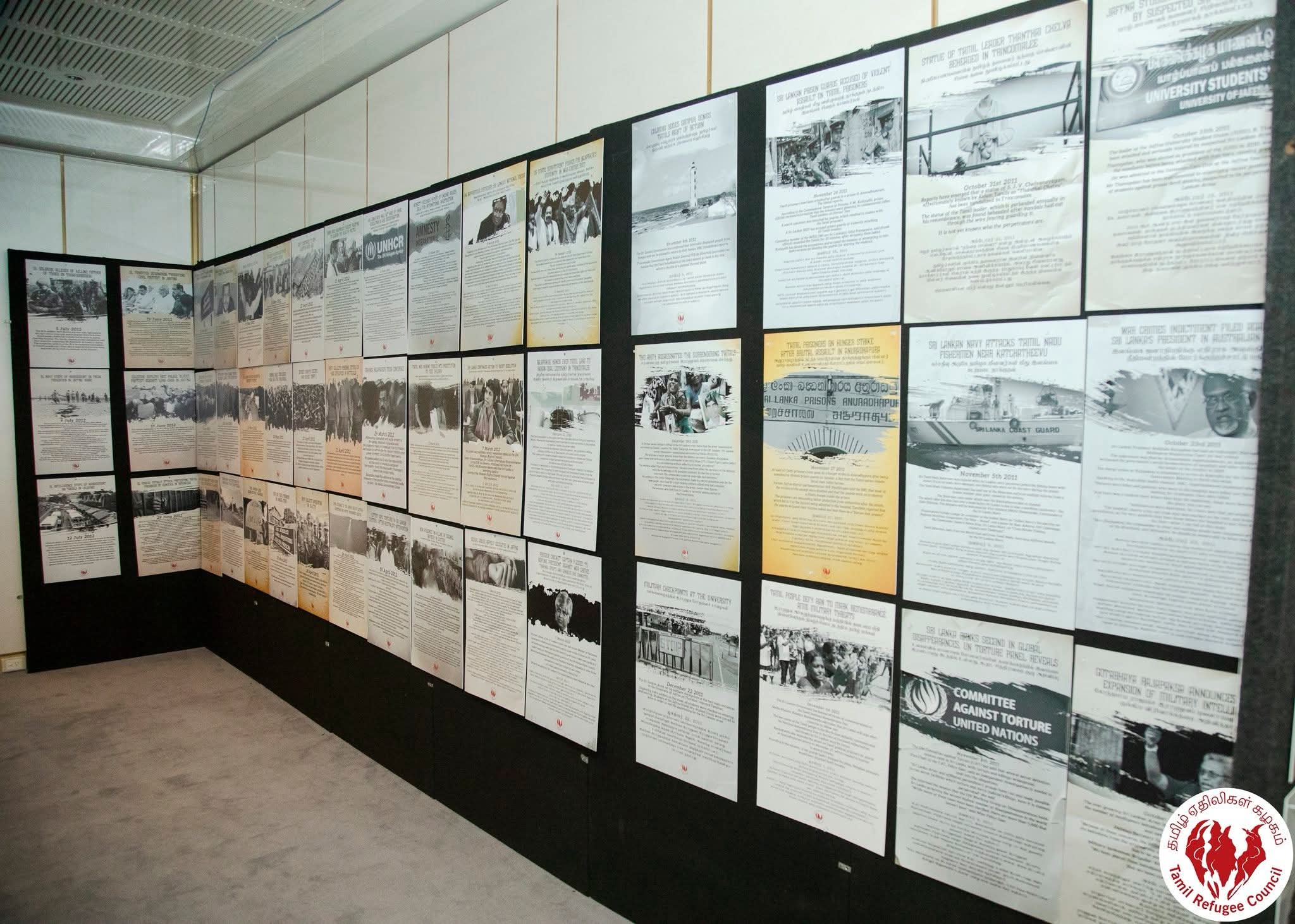
An exhibition documenting allegations of genocide, ongoing repression and human rights violations against Eelam Tamils was held inside Australia’s Parliament House during Tamil Genocide Remembrance Week, bringing renewed attention to the continuing plight of Tamils in the North-East homeland.
Organised by the Tamil Refugee Council, the Tamil Genocide Truth Telling Exhibition concluded during the remembrance period marking the Mullivaikkal genocide of May 2009, when tens of thousands of Tamil civilians were killed during the final stages of the Sri Lankan military offensive.
The exhibition sought to document decades of violence against the Tamil nation, whilst highlighting continuing concerns over militarisation, enforced disappearances, land occupation, mass graves, cultural destruction and the persistent denial of justice and accountability in Sri Lanka.
Organisers stated that the exhibition also included testimonies from survivors and witnesses of the final stages of the armed conflict, alongside documentation relating to the atrocities committed at Mullivaikkal and their lasting impact on Tamil families and communities.
The event took place as Tamils across the world marked the 17th anniversary of the Mullivaikkal genocide through remembrance events, protests, vigils and political campaigns calling for international accountability and recognition of the genocide against Eelam Tamils.
The exhibition was officially opened by David Shoebridge, who argued that the atrocities committed at Mullivaikkal should not be viewed as an isolated event but as part of a pattern of repression against the Tamil people.
"When we're reflecting on the Tamil genocide, we often think of the appalling Mullivaikkal massacre in 2009," Shoebridge said. "But what this exhibition shows is that it was not an isolated incident. It was part of a pattern of repression against the Tamil people that happened for decades before and has happened in the 15 or 16 years since as well."
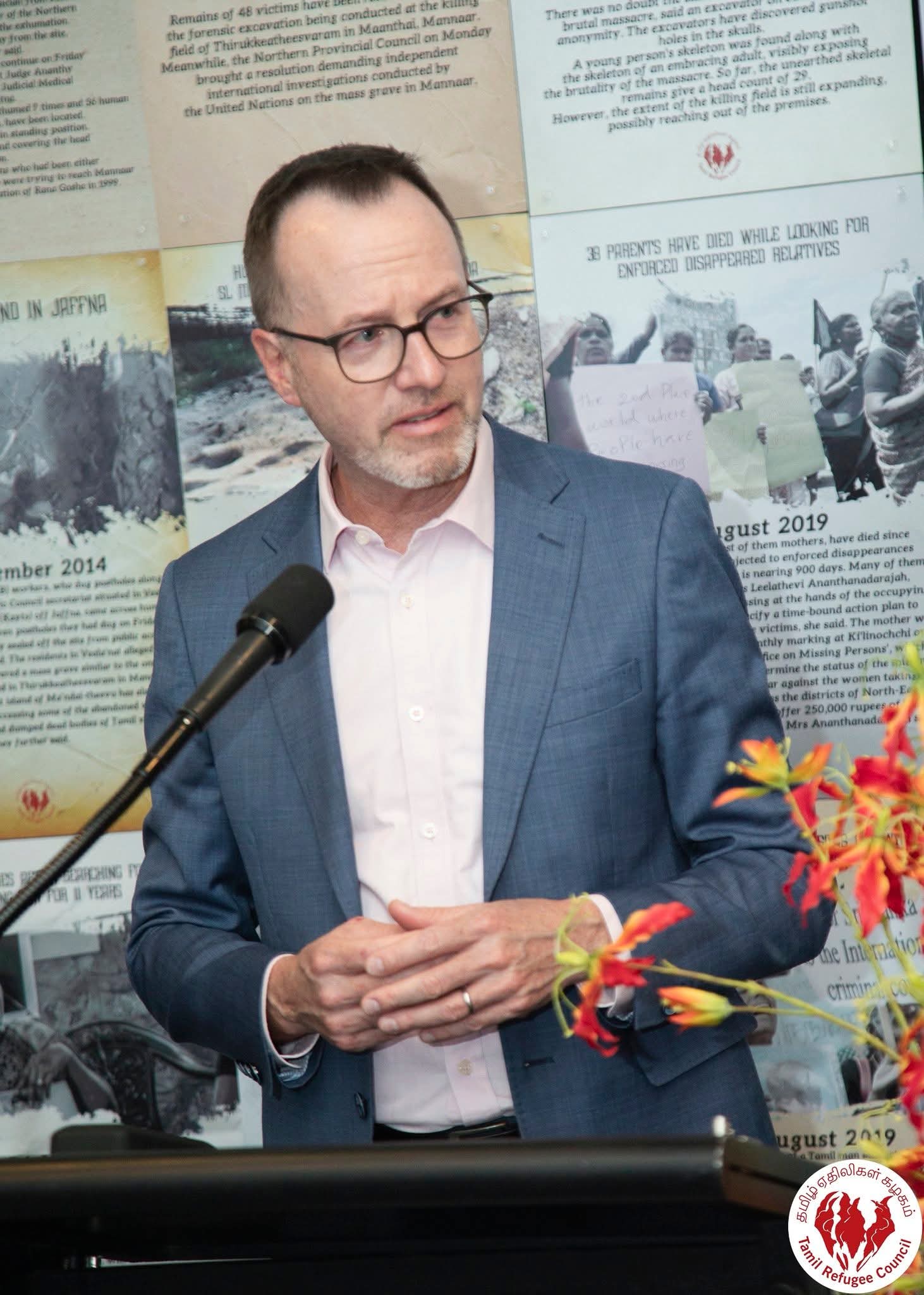
Shoebridge further called on the Australian government to formally recognise the Tamil genocide and re-examine its policies relating to Sri Lanka.
"I would hope we get to a point where our government formally acknowledges the Tamil genocide," he said. "We should tell the truth about how Australia funded the Sri Lankan government to prevent Tamils fleeing the violence from 2009 onwards."
He also criticised the country information used by Australia's Department of Foreign Affairs and Trade (DFAT), arguing that official assessments did not accurately reflect conditions faced by Tamils.
"DFAT refers officers to its country assessment of Sri Lanka, which says there is no ongoing oppression of the Tamil people, that they can return safely without facing oppression. That is plainly not true," he said.
Among those attending the exhibition were senator Lidia Thorpe, Dr Andrew Charlton MP, Senator Mehreen Faruqi, Senator Steph Hodgins-May, Senator Penny Allman-Payne, MP Tony Zappia, MP Ash Ambihaipahar, ASRC CEO Jana Favero and academic Emeritus Professor John Minns.
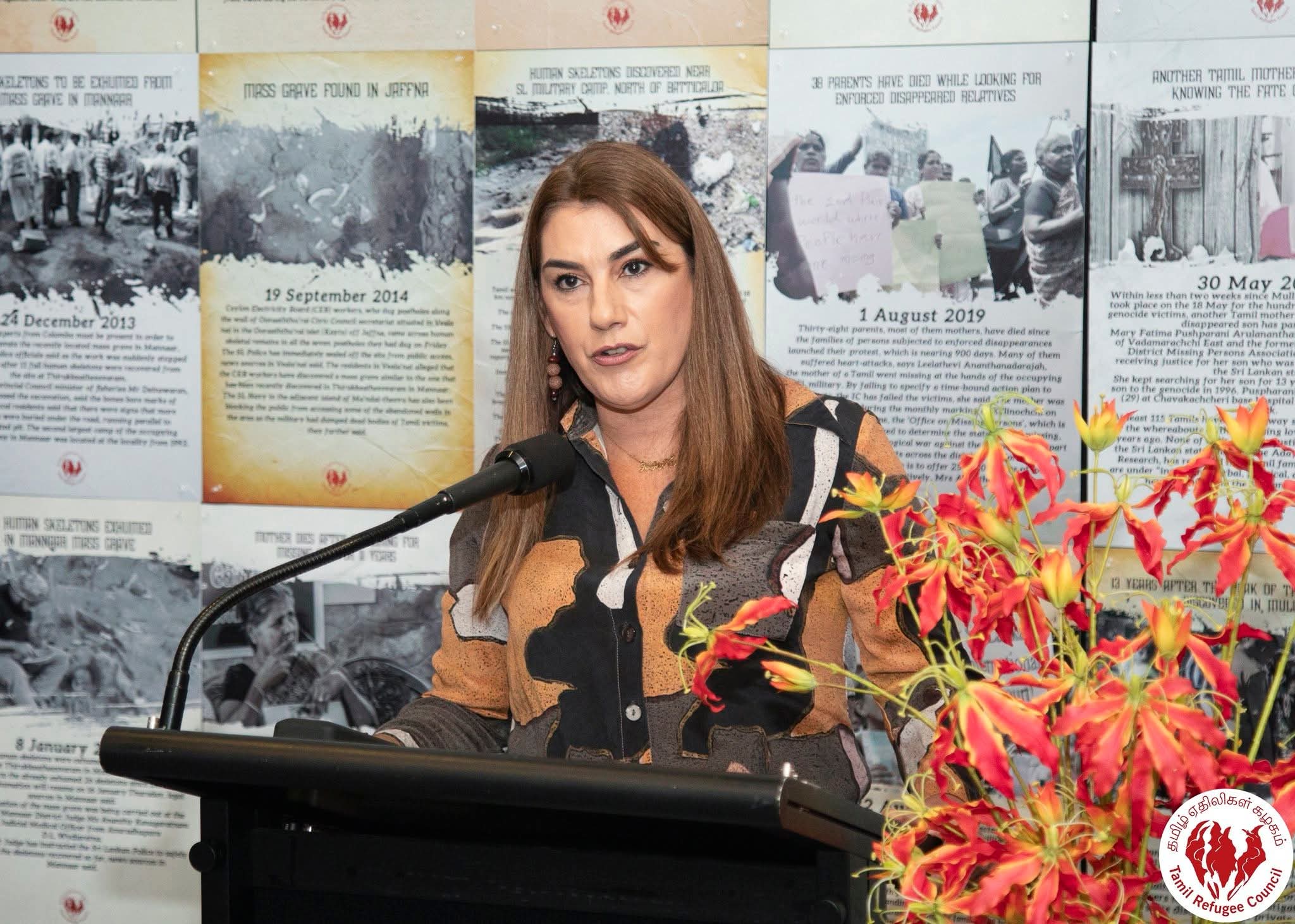
Addressing attendees, senator Lidia Thorpe described the violence against Tamils as a long-running genocide that continued beyond the end of the armed conflict in 2009.
"The Tamil genocide started in 1948 and peaked in 2009 with the Mullivaikkal massacre, where at least 146,000 Tamils were systematically trapped and killed," she said. "But it did not stop with the Sri Lankan government's declaration of the end of the civil war the same year."
She said Tamils had continued to face displacement, loss of land, economic destruction and systemic discrimination, citing repeated concerns raised by United Nations mechanisms regarding alleged war crimes, crimes against humanity and systemic persecutions against Tamils.
"These are not isolated incidents. They are systemic, with the aim of eradicating the Tamil people. This is genocide," Thorpe said.
Calling for greater recognition of Tamil grievances, Thorpe told members of the Tamil community that they were welcome and supported in Australia, adding that acknowledgement of genocide was an essential step towards justice.
"The first step towards justice is recognising that it's a genocide, an ongoing genocide," she said.
Organisers said the exhibition was not simply about remembering the past, also about "truth telling, resisting erasure, and demanding justice, accountability and self-determination for the Tamil nation".