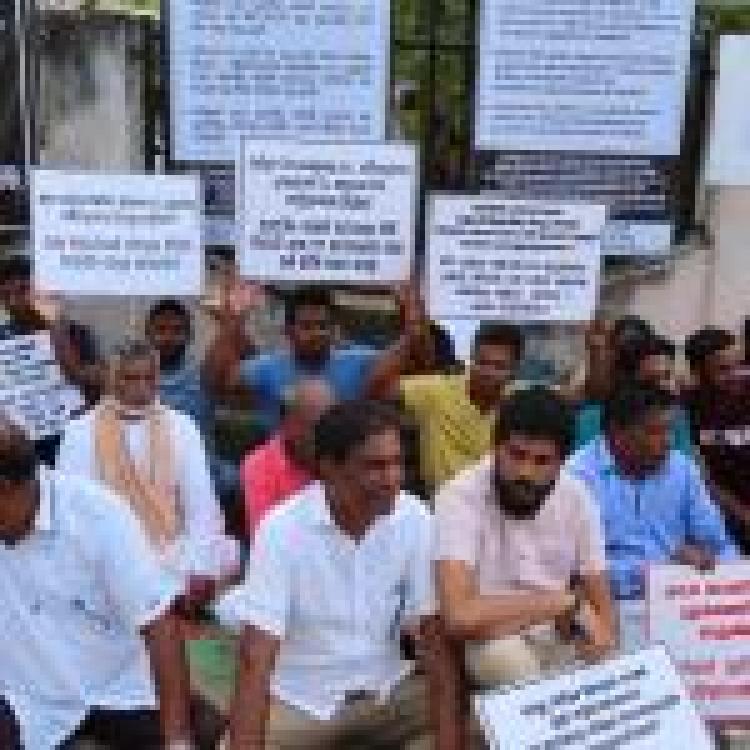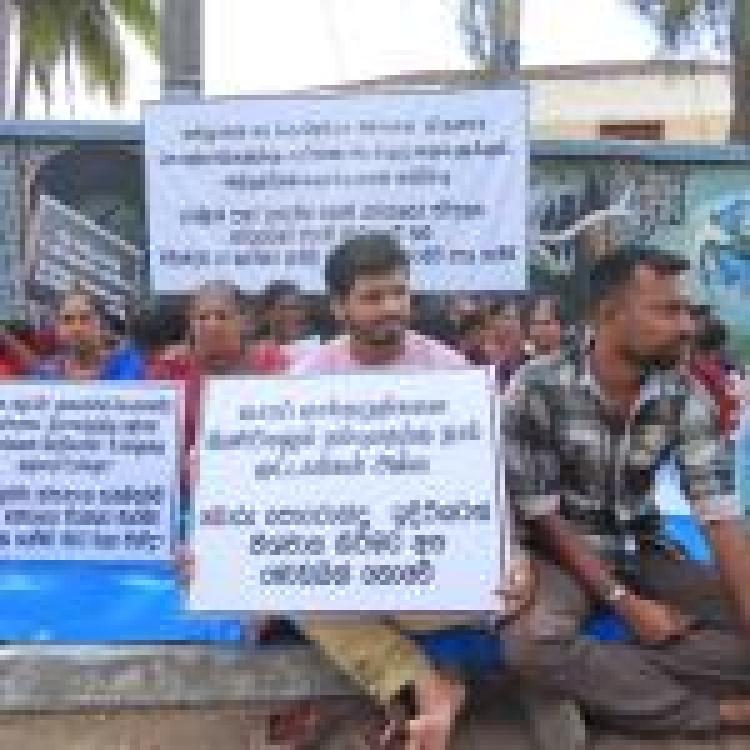

Activists in Kalmunai have accused the Sri Lankan government of enabling an unlawful, racially driven land occupation in a Tamil-majority area, warning that the Anura Kumara Dissanayake administration’s claims of being “free from ethnic and religious divisions” ring hollow as long as such incidents continue.
The remarks were made at a special press briefing held at the Kalmunai Press Club, following an altercation earlier in the week in which private individuals, accompanied by officials from the Kalmunai South Divisional Secretariat, arrived near the Sri Lanka Bank junction on the western side of Kalmunai to begin constructing a row of food stalls.
Former Kalmunai Municipal Council member Chandrasekaram Rajan, social activist T. Pradeepan, and Women’s Association leader S. Nithyakaileswari led the briefing, condemning what they described as an attempt to seize land within the Kalmunai North boundary without approval and under the guise of development.
Rajan told reporters that the individual who first appeared on the site had claimed to possess a 30-year land lease but fled when asked to produce documentation. Later, officials from the Kalmunai Muslim Divisional Secretariat arrived, asserting that they had received permission from the Road Development Authority (RDA) to construct shops.
However, Rajan said the RDA engineer had informed him that the approval granted was only for placing a container for business purposes, not for any form of permanent construction. He noted that the same RDA had previously refused to permit the installation of a name board in Veeramunai, despite a District Coordinating Committee decision, yet now appeared willing to authorise construction in this instance.
He alleged that while roadside vendors and small stalls were being removed in other parts of the region, permission had been selectively granted here, reflecting ethnic bias within the RDA and provincial authorities. “These discriminatory practices must be brought to the attention of a government that claims to be non-ethnic,” Rajan said, adding that activists planned to pursue legal action.
The activists also stressed that the disputed land lies on a floodplain. Blocking the area, they warned, would cause severe flooding similar to previous years when natural drainage paths were obstructed. They demanded that all construction work be halted immediately.
Rajan pointed to broader neglect in Tamil areas of Kalmunai, including unmaintained roads, the absence of functioning streetlights, and poor administrative responsiveness. He also referenced the Santhangeni Ground, which had once been a pond before being filled and converted into a field, as evidence of how environmentally sensitive areas were being altered without regard for local welfare.
He further alleged that with elections approaching, such racially motivated activities were being pursued for political advantage. Calling on Tamil, Muslim and Sinhala residents alike, the activists urged communities not to be manipulated by divisive agendas.
The group concluded by reiterating that construction on the disputed land should be stopped immediately, warning that they would continue to resist what they say is an unlawful and discriminatory land appropriation.